
Sericostomatidae
Stephens, 1836
Bushtailed Caddisflies
Genus Guides
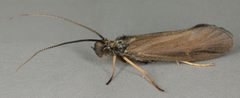
2is a of caddisflies (Trichoptera) commonly known as bushtailed caddisflies. The family comprises approximately 19 and at least 90 described . Larvae construct portable cases using silk and environmental materials. The family has a global distribution with notable diversity in the Palearctic region, including species in the Balkans, Iberian Peninsula, and Madagascar.
Pronunciation
How to pronounce Sericostomatidae: //ˌsɛrɪkoʊˈstoʊmətɪdiː//
These audio files are automatically generated. While they are not always 100% accurate, they are a good starting point.
Images
Habitat
Freshwater stream and river . Larvae inhabit lotic environments, with specific documented from mountain streams in Central Greece, the western Alps, Apennines, and coastal mountain streams in California. Some species show bioclimatic preferences for Mediterranean and temperate montane conditions.
Distribution
Widespread across multiple biogeographic regions. Documented from: European Ecoregion 3 (Italy, Corsica, Malta), European Ecoregion 6 (Hellenic western Balkan region, specifically mountains of Central Greece), French, Italian, and Swiss western Alps, Apennines, Iberian Peninsula, Turkey, Caucasus, Transcaucasia, Iran, Madagascar, and North America (including California and Canada). Northernmost South American record from Roraima state, Brazil.
Diet
Larvae function as , consuming leaf litter. Schizopelex festiva has been documented feeding on conditioned chestnut and oak leaves.
Life Cycle
Sericostoma personatum exhibits a three-year in Danish springs, with growth retardation observed during winter months attributed to lower temperatures. A 1.5-year life cycle has also been reported for this in other , with food quality and temperature suggested as explanatory factors.
Behavior
Larvae are case-builders that construct portable cases incorporating silk and environmental materials. Gumaga nigricula larvae demonstrate sedentary during low-flow periods, with most individuals remaining within 4 m of release points after 24 days. During high-flow events, downstream increases, with dispersal distances of 18 m and maximum recorded distances of 222 m for larvae, and up to 436 m for pupae.
Ecological Role
functional group in stream , processing leaf litter and contributing to nutrient cycling. As shredders, they influence energy transfer and organic matter breakdown in freshwater . Secondary salinization negatively affects performance through reduced metabolic rates, with potential cascading effects on stream food webs.
Human Relevance
Used as bioindicators for freshwater health and stream quality assessments. Molecular identification tools are increasingly employed to resolve cryptic and prevent erroneous biodiversity assessments. Sensitive to anthropogenic stressors including water salinization, which reduces survival, growth, and feeding .
Similar Taxa
- HelicopsychidaeBoth belong to the superfamily Sericostomatoidea and share case-building larval habits; distinguished by case and genitalia.
- PetrothrincidaeFormerly included within Sericostomatoidea; Petrothrincidae was elevated to status, with Gyrocarisa synonymized under Petrothrincus based on morphological and molecular evidence.
Sources and further reading
- BugGuide
- Wikipedia
- GBIF taxonomy match
- iNaturalist taxon
- NCBI Taxonomy
- Catalogue of Life
- The larva of Schizopelex huettingeri Malicky 1974 (Trichoptera: Sericostomatidae), including a preliminary key to the Sericostomatidae larvae of the Hellenic western Balkan region
- Case-building behaviour ofPycnocentrodes aeris(Trichoptera : Sericostomatidae)
- The larva of Sericostoma galeatum Rambur 1842 (Trichoptera: Sericostomatidae), based on French material
- Diversity of Sericostomatidae (Trichoptera) Caddisflies in the Montseny Mountain Range
- Eleven new species of Sericostomatoidea from Madagascar (Trichoptera: Helicopsychidae, Petrothrincidae, Sericostomatidae)
- A new species of genus Schizopelex McLachlan (Trichoptera, Sericostomatidae), from the southern Iberian Peninsula
- The larvae of Sericostoma sasbaddes Malicky 2010, S. maclachlanianum Costa 1884, S. clypeatum Hagen 1864, and S. siculum McLachlan 1876 (Trichoptera: Sericostomatidae), including a preliminary key to the Sericostomatidae larvae of European Ecoregion 3 (Italy, Corsica, and Malta)
- Life Cycle and Growth of Sericostoma personatum Spence (Trichoptera, Sericostomatidae) in a Danish Spring
- A key to larvae and pupae of Sericostoma personatum (Spence) and Notidobia ciliaris (Linné) (Sericostomatidae : Trichoptera) in Britain
- First record of the caddisfly Notidobiella amazoniana Holzenthal & Blahnik, 2010 (Trichoptera, Sericostomatidae) from Roraima state, northern Brazil
- REVISION DES TRICHOPTèRES CANADIENS : III. Les Hyalopsychidae, Psychomyiidae, Goeridae, Brachycentridae, Sericostomatidae, Helicopsychidae, Beraeidae, Odontoceridae, Calamoceratidae et Molannidae
- Effects of water salinization and substrata quality on the performance of the shredder Schizopelex festiva (Trichoptera; Sericostomatidae)
- Long‐term movements of self‐marked caddisfly larvae (Trichoptera: Sericostomatidae) in a California coastal mountain stream
- <i>Psilotreta Indecisa</i> and <i>Agarodes Distinctus</i> (Trichoptera: Odontoceridae, Sericostomatidae): New State Records and Notes on the Habitat of These Species in Michigan
- Spatial distribution on river banks ofIsoperla nevada(Plecoptera, Perlodidae),Chloroperla nevada(Plecoptera, Chloroperlidae) andSericostomacf.vittatum(Trichoptera, Sericostomatidae)