
Apataniidae
Wallengren, 1886
Early Smoky Wing Sedges
Genus Guides
2- Apatania
- Pedomoecus(early smoky wing sedges)
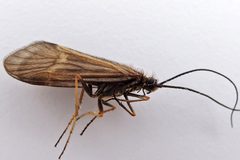
Apataniidae is a of caddisflies (Trichoptera) commonly known as early smoky wing sedges. The family contains approximately 18 and at least 180 described . Members are primarily Holarctic in distribution, with notable diversity in Europe, Asia, and North America. Larvae are aquatic and construct portable cases from mineral particles.
Pronunciation
How to pronounce Apataniidae: /ˌæpəˌtænˈiːaɪdiː/
These audio files are automatically generated. While they are not always 100% accurate, they are a good starting point.
Identification
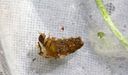
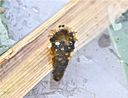
Larvae of Apataniidae can be distinguished from similar caddisfly by morphological features including the presence of long, tapering setae with flexible or flexuous tips at the border of the pronotum. European Apataniana larvae possess a distinctive Y-shaped osmeterium (defensive gland appendix) at the cervix between pronotum and . Larval cases are curved, tapering, and constructed from mineral particles, sometimes with wing-like lateral structures. are identified by genitalia , with increasingly used to clarify boundaries in morphologically similar .
Images
Habitat
Larvae inhabit small streams, particularly headwater and high-altitude systems. Documented elevations range from 700 m to above tree line at 1750 m a.s.l. Larvae are associated with water moss in some . Specific preferences vary by and species, with some showing narrow micro- distributions in isolated mountain ranges.
Distribution
Holarctic distribution with centers of diversity in Europe (Alps, Hellenic Western Balkan, Scandinavia, British Isles), Asia (Siberia, Central Asia, Himalaya, Mongolia, Tibet, Russia), and North America (western United States). Some exhibit highly restricted ranges; for example, Apatania helvetica is known only from Switzerland, Apatania theischingerorum exclusively from the Iberian peninsula, and three Apataniana species are to specific Greek mountain systems.
Seasonality
periods vary by and region. In North American Allomyia, adult emergence timing has been documented. Larval collections from Greece in July, August, and October suggest seasonal development patterns, with 5th instar larvae present during summer and autumn months.
Diet
Larvae possess scraper-type without terminal teeth along the cutting edge, indicating a scraping feeding mode on periphyton or detritus.
Life Cycle
Larvae construct portable mineral cases and develop through multiple instars; 5th instar larvae have been described for several . Some members of the Apatania reproduce parthenogenetically, including the Apatania muliebris Complex. -based methods have been used to associate larval and stages for species where larvae were previously unknown.
Behavior
Larvae construct curved, tapering portable cases from mineral particles. Defensive includes extension of the osmeterium (Y-shaped glandular appendix) in Apataniana larvae; when threatened, the underlying gland produces a mixture of up to 40 as a chemical defense against predatory .
Ecological Role
Larvae function as primary consumers and scrapers in small stream . Their restricted distributions and specificity make some potential indicators for specific ecoregions, such as the Hellenic Western Balkan ecoregion for European Apataniana.
Human Relevance
Used as bioindicators for freshwater health and ecoregion characterization. Subject of ongoing taxonomic research using and mitogenomics to resolve phylogenetic relationships and boundaries.
Similar Taxa
- LimnephilidaeBoth are within Limnephiloidea; Apataniidae larvae distinguished by specific pronotal setation patterns and case .
- GoeridaeAnother Limnephiloidea with case-building larvae; Apataniidae separated by larval structure and defensive gland presence in some .
Sources and further reading
- BugGuide
- Wikipedia
- GBIF taxonomy match
- iNaturalist taxon
- NCBI Taxonomy
- Catalogue of Life
- DNA-barcoding clarifies species definitions of Finnish <i>Apatania</i> (Trichoptera: Apataniidae)
- The larvae of the European species of genus Apataniana Mosely, 1936 (Trichoptera, Apataniidae): descriptions, key and ecology
- DNA-based association and description of the larval stage of Apatania helvetica Schmid 1954 (Trichoptera, Apataniidae) with notes on ecology and zoogeography
- DNA-based association and description of the larval stage of Apatania theischingerorum Malicky 1981 (Trichoptera, Apataniidae), with notes on its ecology
- <p class="HeadingRunIn"><strong>New species of <em>Allomyia </em>Banks from the Western United States (Trichoptera: Apataniidae)</strong></p>
- Length-mass relationships and seasonal dynamics of Apatania crymophila McLachlan, 1880 (Trichoptera: Apataniidae) caddisfly larvae associated with water moss in the middle reaches of the Yenisei River (Siberia)
- Figure 27 from: Waringer J, Malicky H (2016) The larvae of the European species of genus Apataniana Mosely, 1936 (Trichoptera, Apataniidae): descriptions, key and ecology. ZooKeys 586: 121-134. https://doi.org/10.3897/zookeys.586.7758
- Figures 1–4 from: Waringer J, Malicky H (2016) The larvae of the European species of genus Apataniana Mosely, 1936 (Trichoptera, Apataniidae): descriptions, key and ecology. ZooKeys 586: 121-134. https://doi.org/10.3897/zookeys.586.7758
- Figures 5–11 from: Waringer J, Malicky H (2016) The larvae of the European species of genus Apataniana Mosely, 1936 (Trichoptera, Apataniidae): descriptions, key and ecology. ZooKeys 586: 121-134. https://doi.org/10.3897/zookeys.586.7758
- Figures 12–18 from: Waringer J, Malicky H (2016) The larvae of the European species of genus Apataniana Mosely, 1936 (Trichoptera, Apataniidae): descriptions, key and ecology. ZooKeys 586: 121-134. https://doi.org/10.3897/zookeys.586.7758
- Figures 19–26 from: Waringer J, Malicky H (2016) The larvae of the European species of genus Apataniana Mosely, 1936 (Trichoptera, Apataniidae): descriptions, key and ecology. ZooKeys 586: 121-134. https://doi.org/10.3897/zookeys.586.7758
- Mitogenomics Provide New Phylogenetic Insights of the Family Apataniidae (Trichoptera: Integripalpia).