
Glossosoma
Curtis, 1834
little black caddisflies
Species Guides
1- Glossosoma nigrior(little black caddisfly)
Glossosoma is a of small comprising over 110 described , commonly known as little black caddisflies. Larvae construct portable dome-shaped cases from mineral particles and occupy the upper surfaces of stones in flowing waters. The genus exhibits multivoltine with varying times among species.
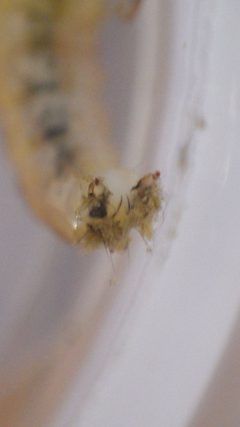
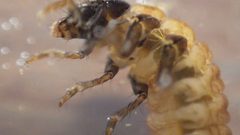
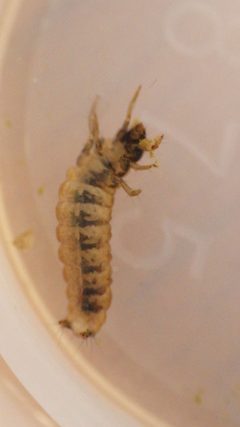
Pronunciation
How to pronounce Glossosoma: //ˌɡlɒsəˈsəʊmə//
These audio files are automatically generated. While they are not always 100% accurate, they are a good starting point.
Identification
Larvae recognized by their distinctive dome-shaped portable cases constructed from sand grains and small mineral particles. Cases may be perforated with gaps or closed; perforated cases are associated with high-current . are small, dark-colored with reduced body size relative to other glossosomatid . Larval possess a self-sharpening mechanism: the medial of the mandible tip is softer and more flexible than the lateral cuticle, resulting in differential abrasion that maintains sharp cutting edges.
Images
Habitat
Larvae inhabit the upper surfaces of stones in streams and rivers with moderate to high current velocities. Occupies riffle zones and areas with coarse substrata; absent from muddy or sandy bottoms. Distribution within streams correlates with hydraulic variables including streamwise velocity, spatial velocity fluctuation, and spanwise vorticity.
Distribution
Widespread in the Northern Hemisphere. Documented from Europe (excluding Scandinavia and southern Balkan, extending east to north- and northwest Russia), Asia (Japan, China including Qinghai Province), and North America (United States including Vermont and Alabama, distribution records from Denmark, Norway, Sweden).
Seasonality
active from April to October in European . Multivoltine exhibit overlapping ; specific species show three to four generations per year depending on thermal regime and potential summer .
Diet
Larvae scrape epilithic and detritus from rock surfaces using as excavators. Grazes on biofilms covering submerged stones in lotic environments.
Life Cycle
Holometabolous development with aquatic larval and pupal stages and terrestrial stage. Multivoltine: time varies by and thermal regime, with documented cases of three to four generations annually. Larval instars construct progressively larger cases with distinct particle size distributions. occurs within the portable case.
Behavior
Larvae lack undulatory locomotory and depend on current flow for respiratory , explaining their preference for high-velocity . Case construction behavior varies: larvae build dome-shaped cases with or without perforations; gaps in cases enhance passive gaseous exchange via water flow. function as excavators with a self-sharpening mechanism maintained through differential abrasion of softer medial versus harder lateral surfaces.
Ecological Role
Grazer in freshwater stream , removing biofilms and from rock substrates. Serves as a bioindicator for monitoring restoration of natural sediment regimes; case material requirements reflect ambient sediment availability and particle size distributions. Contributes to secondary production in stream .
Human Relevance
Recognized as an indicator for stream health assessment and sediment restoration management. Used in studies linking computational fluid dynamics and benthic macroinvertebrate distribution to predict suitability. Subject of research on biomaterial adaptations, particularly the self-sharpening mechanism.
Similar Taxa
- AgapetusAlso in Glossosomatidae with case-building larvae, but Glossosoma larvae construct dome-shaped cases whereas Agapetus cases differ in form; Glossosoma larvae specifically occupy upper stone surfaces and lack undulatory .
- ProtoptilaShares Glossosomatidae and case-bearing habit; Glossosoma distinguished by multivoltine , specific adaptations for grazing, and preference for high-current riffle .
Sources and further reading
- BugGuide
- Wikipedia
- GBIF taxonomy match
- iNaturalist taxon
- NCBI Taxonomy
- Catalogue of Life
- Mandible mechanical properties and composition of the larval Glossosoma boltoni (Trichoptera, Insecta)
- Effect of current velocity and case adaptations on the distribution of caddisfly larvae (Glossosoma, Trichoptera)
- Life history, voltinism and portable case characteristics of Glossosoma (Trichoptera: Insecta) in the Tama River, Japan
- Life history and secondary production of Glossosoma nigrior Banks (Trichoptera: Glossosomatidae) in two Alabama streams with different geology
- Life cycles ofGlossosoma inopsandAgapetus yasensis(Trichoptera, Glossosomatidae) at Kii Peninsula, Southern Honshu, Japan
- Description of adult female, larva, and pupa of Glossosoma (Lipoglossa) kamael Malicky 2012 (Trichoptera: Glossosomatidae) associated by COI sequences from China
- Life cycle and drift of Glossosoma intermedia (Trichoptera: Glossosomatidae) in western Norway
- Studies on the Life Cycle and Transmission of <i>Cougourdella</i> Sp., A Microsporidian Parasite of <i>Glossosoma Nigrior</i> (Trichoptera: Glossosomatidae)
- Prediction of Glossosoma biomass spatial distribution in Valley Creek by field measurements and a three‐dimensional turbulent open‐channel flow model