
Glossosoma nigrior
Banks, 1911
little black caddisfly
Glossosoma nigrior is a caddisfly in the Glossosomatidae, commonly known as the little black caddisfly. It is native to North America and has been extensively studied in Michigan trout streams and Alabama streams. The species exhibits respiratory adaptations to flowing water conditions and serves as a benthic grazer in stream .
Pronunciation
How to pronounce Glossosoma nigrior: /ˌɡloʊsəˈsoʊmə ˈnɪɡriˌɔr/
These audio files are automatically generated. While they are not always 100% accurate, they are a good starting point.
Identification
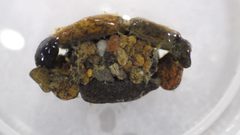
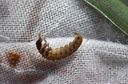
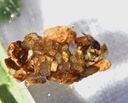
Distinguished from other Glossosoma by geographic distribution and specific associations. Larval cases are constructed from small mineral particles bound with silk, characteristic of the Glossosomatidae. are small and black in coloration.
Images
Appearance
Small black caddisfly. Larvae construct portable cases typical of Glossosomatidae, using silk and small stones or sand particles.
Habitat
Freshwater lotic systems, specifically streams and rivers. In Michigan, occurs in trout streams as the benthic . In Alabama, found in both sandstone-underlain streams (Appalachian Plateau) and limestone-underlain streams (Valley and Ridge physiographic province). Prefers streams with stable hydrology, optimal availability, and warmer winter water temperatures.
Distribution
North America. Documented from Michigan, Alabama, and Vermont in the United States. Occurs in the Nearctic region.
Seasonality
active during warmer months. In Alabama, exhibits continuous larval growth throughout the year due to favorable thermal conditions.
Diet
(>50%) and detritus (>40%). Functions as a scraper, grazing on periphyton and organic material from submerged surfaces.
Host Associations
- Cougourdella sp. - microsporidian /Strongly regulates larval . Both sexes of can be infected with mature environmental spores, but spores are not associated with reproductive tissue. Oral and transovum transmission routes do not appear to occur.
Life Cycle
Trivoltine (three per year) in warmer southern streams, attributed to higher water temperature regimes than northern . Larval stage aquatic and benthic; stage terrestrial but returns to streams. Larvae construct portable cases and maintain continuous growth in optimal conditions.
Behavior
Larvae exhibit behavioral responses to fluid flow conditions affecting oxygen delivery. At low Peclet numbers (Pe < 87), larvae occasionally abandon cases or spend more time partially extended from cases due to insufficient oxygen delivery. At higher flow velocities (Pe > 87), larvae typically remain within cases. Larvae increase oxygen uptake rates in response to increased fluid flow velocity.
Ecological Role
benthic grazer in Michigan trout streams and important contributor to secondary production in Alabama streams. Contributes >80% of secondary production through consumption in some systems. Functions as a key trophic linkage between primary producers and higher consumers in stream .
Human Relevance
Serves as a bioindicator for stream health and water quality. Used in ecological studies of stream metabolism and secondary production. are studied as a model for understanding regulation of .
Similar Taxa
- Other Glossosoma speciesShare similar case-building and preferences; distinguished by geographic range and specific stream associations
- Other Glossosomatidae generaSimilar case using silk-bound mineral particles; distinguished by case architecture and larval morphology
More Details
Respiratory Physiology
Laboratory studies demonstrate that oxygen uptake increases with fluid flow velocity. The flux of dissolved oxygen to larvae and their cases can be up to seven times larger in moving fluid compared to stagnant conditions. A functional relationship exists where the Peclet number alone describes 91% of variation in oxygen flux under variable flow conditions.
Pathogen Ecology
The microsporidian Cougourdella sp. strongly regulates larval , representing an important top-down control mechanism in stream . Transmission does not occur orally or transovum, suggesting an intermediate may be required.
Sources and further reading
- BugGuide
- Wikipedia
- GBIF taxonomy match
- iNaturalist taxon
- NCBI Taxonomy
- Life history and secondary production of Glossosoma nigrior Banks (Trichoptera: Glossosomatidae) in two Alabama streams with different geology
- Studies on the Life Cycle and Transmission of <i>Cougourdella</i> Sp., A Microsporidian Parasite of <i>Glossosoma Nigrior</i> (Trichoptera: Glossosomatidae)
- Glossossoma nigrior (Trichoptera: Glossosomatidae) respiration in moving fluid