
Glossosomatidae
Wallengren, 1891
tortoise-case makers, saddle-case makers, little black caddisflies
Genus Guides
3- Agapetus(Agapetus caddisflies)
- Glossosomatinae
- Protoptilinae
is a of caddisflies (order Trichoptera) containing 23 across three . Larvae construct distinctive domed cases from pebbles bound with silk, giving rise to the "tortoise-case makers" or "." The family has a worldwide distribution with particular diversity in the Americas. Larvae are primarily found in cool, fast-flowing streams where they serve as important bioindicators of water quality due to their sensitivity to pollution and long aquatic life stages.
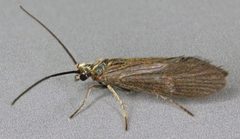
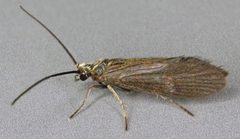
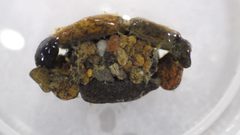
Pronunciation
How to pronounce Glossosomatidae: //ˌɡlɒsoʊsəˈmætɪˌdiː//
These audio files are automatically generated. While they are not always 100% accurate, they are a good starting point.
Identification
Larvae distinguished from other caddisfly by domed, tortoise-like cases constructed from pebbles; lack of prosternal horn; and presence of on 9th abdominal segment. recognized by combination of three ocelli, 5-segmented maxillary palps with rounded 2nd segment, paired round mesoscutellar warts, and absence of preapical spurs on fore tibia.
Images
Habitat
Fast-flowing, cool mountain springs and streams with high dissolved oxygen. Larvae cling to submerged logs and rocks, often in areas with growth.
Distribution
Worldwide. Protoptilinae shows disjunct distribution: 5 in East Palaearctic and Oriental regions, 13 genera in Nearctic and Neotropical regions. Documented from North America (76+ ), South America (southeastern Brazil, Chile, Argentina), Europe, Asia Minor, and Australia.
Diet
Larvae scrape, graze, and consume and fine particulate matter from submerged surfaces.
Life Cycle
Larvae construct cases during first instar and rebuild when outgrown. Larval development spans months to years depending on and temperature; cold conditions increase longevity. Some species (5-10 month cycles), others trivoltine with spanning 6-7 months and warm-season generations 2-3 months. occurs within silken cocoon inside case, which is fastened to rocks; pupal stage lasts approximately one month unless in . Pupae are exarate and decticous (capable of using ), chewing through silk to float to surface for .
Behavior
Larvae abandon cases or remain partially extended when dissolved oxygen delivery is insufficient (low Peclet number conditions). At higher flow velocities, larvae remain fully within cases. are , flying at night and resting quiescent in vegetation during day. Some adults feed on nectar.
Ecological Role
Important bioindicators of water quality due to sensitivity to pollution, long aquatic residence time, and ease of identification. Serve as prey for fish and other aquatic .
Human Relevance
Used as fishing . Valued as bioindicators for monitoring stream health and detecting water pollution including excess , high mineral concentrations, and chemical .
Similar Taxa
- RhyacophilidaeBoth belong to superfamily Rhyacophiloidea and have larvae in cool, fast-flowing streams; distinguished by pebble case construction versus free-living or silk retreats in Rhyacophilidae.
- HydropsychidaeBoth have larvae in running water with nets or retreats; larvae build portable pebble cases rather than fixed retreats or capture nets.
Sources and further reading
- BugGuide
- Wikipedia
- GBIF taxonomy match
- iNaturalist taxon
- NCBI Taxonomy
- Catalogue of Life
- The larva of Agapetus episkopi Malicky 1972 (Trichoptera: Glossosomatidae), including a key to the larvae of Glossosomatidae of the Hellenic western Balkan region
- The Neotropical caddisfly genus Tolhuaca (Trichoptera: Glossosomatidae)
- The caddisfly genus Protoptila in Costa Rica (Trichoptera: Glossosomatidae)
- Australian species of the genus Agapetus (Trichoptera: Glossosomatidae), with descriptions of 13 new species
- Glossossoma nigrior (Trichoptera: Glossosomatidae) respiration in moving fluid
- Descriptions, Life History and Case-Building Behavior of Culoptila cantha (Trichoptera: Glossosomatidae) in the Brazos River, Texas
- Revision of the austral South American species of Mortoniella (Trichoptera: Glossosomatidae: Protoptilinae)
- The Larva, Pupa and Female of Agapetus jocassee Morse (Trichoptera: Glossosomatidae)
- Life cycle of Agapetus fuscipes (Trichoptera, Glossosomatidae) in a first-order upland stream in central Germany
- Revision and phylogeny of the caddisfly subfamily Protoptilinae (Trichoptera: Glossosomatidae) inferred from adult morphology and mitochondrial DNA
- Life History and Case-Building Behavior of Culoptila cantha (Trichoptera: Glossosomatidae) in the Brazos River, Texas
- Growth, production and mortality of two species of Agapetus (Trichoptera: Glossosomatidae) in the Acheron River, south‐east Australia
- Born from rock: eight new species of Itauara Müller, 1888 (Trichoptera: Glossosomatidae) from southeastern Brazil, including phylogenetic and distributional comments on the genus