
Rhyacophilidae
Stephens, 1836
Free-living Caddisflies
Genus Guides
2- Himalopsyche
- Rhyacophila(caseless caddisflies)
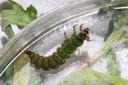
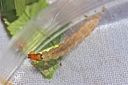
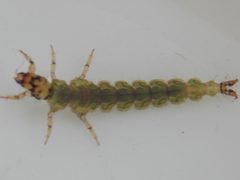
is a of caddisflies (Trichoptera) commonly known as free-living caddisflies. Larvae are distinctive for not constructing portable cases, instead living freely on substrates in freshwater . Most are predatory. The family contains over 700 described species, with the Rhyacophila alone comprising approximately 500 species distributed primarily across the Northern Hemisphere.
Pronunciation
How to pronounce Rhyacophilidae: //raɪˈækəˌfɪlɪˌdiː//
These audio files are automatically generated. While they are not always 100% accurate, they are a good starting point.
Identification
Distinguished from other Trichoptera by the absence of larval cases—larvae are free-living on rocks and debris in streams. separated from similar families by wing venation and genitalic structures; males possess distinctive clasping structures on the for mating. Molecular identification using COI barcoding has revealed high cryptic diversity, with many geographically restricted lineages in montane regions.
Images
Habitat
Flowing freshwater including streams, rivers, and springs; larvae occupy lotic environments from lowland to high-elevation mountain streams (documented from 1022 m to 4381 m elevation in the Hengduan Mountains). Some utilize hyporheic zones—the saturated sediments beneath and alongside stream channels. are often found near larval habitats.
Distribution
Holarctic distribution with greatest diversity in mountainous regions of Asia, Europe, and North America. The Rhyacophila occurs throughout the Northern Hemisphere. Documented from: North America (including California, Vermont, Minnesota, Wyoming, North Carolina), Europe (Denmark, Norway, Sweden), and Asia (Indian Himalayas, Hengduan Mountains of China, Japan, Nepal, Bhutan, Myanmar, Vietnam, Afghanistan).
Seasonality
activity varies by latitude and elevation; in temperate regions, typically occurs from spring through autumn. Adults have been collected using UV light traps operated at dusk for 1–3 hours, indicating activity.
Diet
Larvae are predominantly predatory, feeding on small aquatic . Specific prey items are not well documented for most .
Life Cycle
Complete with , larval, pupal, and stages. Larvae are aquatic and free-living without case construction. occurs in silken retreats attached to substrates in flowing water. Adults are terrestrial and short-lived, functioning primarily for .
Behavior
Larvae are active that move freely over substrates rather than remaining in fixed retreats. are and attracted to ultraviolet light. Many show high geographic fidelity with limited , resulting in restricted ranges and vulnerability to local environmental changes.
Ecological Role
Predatory larvae function as secondary consumers in stream , linking basal resources to higher . Their sensitivity to water quality and alteration makes them potential indicators of stream integrity. High in montane regions contributes to regional biodiversity.
Human Relevance
Used as bioindicators for monitoring stream health and water quality. Larvae are occasionally important as fish food. No significant economic importance as pests or beneficial .
Similar Taxa
- HydropsychidaeBoth have free-living larvae in flowing water, but Hydropsychidae larvae construct fixed retreats with capture nets for filter-feeding, whereas larvae are active without nets.
- PhilopotamidaeLarvae of both lack portable cases, but Philopotamidae larvae are typically smaller, construct silken retreats in seeps and small streams, and have different capsule shapes.
- GlossosomatidaeSometimes confused due to similar , but Glossosomatidae larvae construct distinctive saddle- or tortoise-shaped portable cases from sand grains, unlike the case-less larvae.
More Details
Cryptic diversity
Molecular studies using have revealed substantial unrecognized diversity within Rhyacophila, with many mitochondrial lineages showing restricted geographic distributions and limited between river basins.
Taxonomic complexity
The includes several well-defined groups within Rhyacophila (e.g., angulata group, retracta group, tibetana group) based on male genitalic , though molecular data sometimes support modifications to these groupings.
Sources and further reading
- BugGuide
- Wikipedia
- GBIF taxonomy match
- iNaturalist taxon
- NCBI Taxonomy
- Catalogue of Life
- A REVIEW OF THE RHYACOPHILIDAE (TRICHOPTERA)
- Molecular phylogeny of Himalopsyche (Trichoptera, Rhyacophilidae)
- Females of Rhyacophila (Trichoptera: Rhyacophilidae) from the Indian Himalayas
- Three new species of the Rhyacophila retracta species group (Trichoptera, Rhyacophilidae) from Japan
- Diversity of Rhyacophila (Trichoptera, Rhyacophilidae) in the Hengduan Mountains
- Peculiar hyporheic habitat of some Rhyacophila species (Trichoptera; Rhyacophilidae) in Japanese mountain streams
- Notes on the Rhyacophila angulata Species Group with descriptions of two new species (Insecta, Trichoptera, Rhyacophilidae)
- New Rhyacophilids and Limnephilids (Trichoptera: Rhyacophilidae and Limnephilidae)