
Agapetus
Curtis, 1834
Agapetus caddisflies
Species Guides
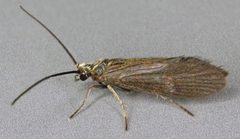
1- Agapetus rossi(little black caddisfly)
Agapetus is a of in the Glossosomatidae, commonly known as saddle-case makers. Larvae construct portable, dome-shaped cases from sand grains and are found in lotic freshwater . The genus has a global distribution with documented across Europe, Asia, Australia, and North America. vary among species, ranging from to trivoltine patterns depending on geographic location and environmental conditions.
Pronunciation
How to pronounce Agapetus: /ˌæɡəˈpiːtəs/
These audio files are automatically generated. While they are not always 100% accurate, they are a good starting point.
Identification
Larvae can be distinguished from other Glossosomatidae by the presence of on all three thoracic nota (pro-, meso-, and ), placing them in Agapetinae. Within the , identification relies on larval case structure, presence or absence of lateral setae on abdominal segments, and coloration patterns of the frontoclypeus. For example, Agapetus episkopi keys with A. laniger and A. delicatulus but differs in frontoclypeus coloration and lateral setae count on abdominal segment I.
Images
Appearance
Larvae construct small, dome-shaped portable cases from sand grains, characteristic of the Glossosomatidae . Larvae of Agapetinae possess on the pro-, meso-, and . Specific morphological features vary by ; for example, Agapetus episkopi lacks lateral setae on abdominal segment III and has a larval case without a sand collar at its base.
Habitat
Freshwater lotic environments, primarily streams and rivers. Australian occur mainly in streams of Tasmania and the Great Dividing Range. Agapetus fuscipes inhabits first-order upland streams. Agapetus quadratus has been documented in temporary spring-fed streams that dry annually during summer. Microdistribution is influenced by flow preferences, with epilithon abundance playing a secondary role in selection.
Distribution
Global distribution including Europe, Asia, Australia, and North America. Specific records from: Denmark, Norway, Sweden, central Germany, the Hellenic western Balkan region, Asia Minor, southern Thailand, Japan (Kii Peninsula, Southern Honshu), and eastern Australia (Tasmania, Great Dividing Range). In North America, Agapetus jocassee is known from streams of the Lake Jocassee catchment in South and North Carolina, with potential wider distribution in the Blue Ridge Escarpment.
Seasonality
Varies by and location. Agapetus fuscipes in central Germany shows from May to August. Agapetus pontona in Australia has a 5–6 month from spring to late summer. Agapetus monticolus in Australia has a 10-month life cycle from autumn to early summer. Agapetus quadratus in Majorca shows trivoltine pattern with recruitment peaks in mid-November, early March, and late June.
Diet
Larvae are grazers feeding primarily on epilithon. Agapetus quadratus derives a major proportion of its production from , with organic detritus as a secondary food source. Agapetus monticolus expresses preference for patches of epilithon with abundant periphyton, though this response varies temporally.
Life Cycle
patterns vary: in Agapetus fuscipes (central Germany) and Agapetus pontona (Australia), with larval development spanning approximately 10 months and 5–6 months respectively; trivoltine in Agapetus quadratus (Majorca) with average cohort time of 4 months and asynchronous larval development. Agapetus monticolus has a 10-month life cycle. typically occurs as larvae, with in spring. Pupation sites appear to be a limiting resource for some .
Behavior
Larvae construct and carry portable dome-shaped cases made of sand grains. Microdistribution is primarily determined by flow preferences, with food availability (epilithon abundance) playing a secondary and temporally variable role. Agapetus monticolus shows -dependent mortality between instar 5 and pupal stage, suggesting competition for sites.
Ecological Role
Primary consumers in lotic , functioning as grazers on epilithic and contributing to secondary production. Agapetus quadratus achieved production of 4.80 g dry mass m−2 year−1 in a Mediterranean stream, among the highest reported for the . Turnover ratios (P/B) range from 1.6–6.3 depending on and environmental conditions.
Human Relevance
Agapetus jocassee is listed as a of Concern by the U.S.D.I. Fish and Wildlife Service due to its restricted range. Agapetus fuscipes has been used as a test organism in studies examining cadmium effects on different larval instars.
Similar Taxa
- GlossosomaAlso in Glossosomatidae; larvae construct similar dome-shaped cases from sand grains but lack the thoracic arrangement characteristic of Agapetinae
- ProtoptilaMember of Glossosomatidae with different larval case and thoracic patterns
More Details
Growth rates
Maximum larval growth rates of 1.8–2.2% dry weight day−1 have been documented for Australian during summer periods, with higher rates associated with lower levels of substrate disturbance.
Population regulation
-dependent pupal mortality has been observed in Agapetus pontona, with higher larval densities leading to greater pupal mortality, suggesting competition for sites. This pattern was not observed in Agapetus monticolus, possibly due to unpredictable discharge conditions during its spring pupation period.
Sources and further reading
- BugGuide
- Wikipedia
- GBIF taxonomy match
- iNaturalist taxon
- NCBI Taxonomy
- Catalogue of Life
- The Larva, Pupa and Female of Agapetus jocassee Morse (Trichoptera: Glossosomatidae)
- Australian species of the genus Agapetus (Trichoptera: Glossosomatidae), with descriptions of 13 new species
- Life cycle of Agapetus fuscipes (Trichoptera, Glossosomatidae) in a first-order upland stream in central Germany
- The larva of Agapetus episkopi Malicky 1972 (Trichoptera: Glossosomatidae), including a key to the larvae of Glossosomatidae of the Hellenic western Balkan region
- Growth, production and mortality of two species of Agapetus (Trichoptera: Glossosomatidae) in the Acheron River, south‐east Australia
- Life history and production of Agapetus quadratus (Trichoptera: Glossosomatidae) in a temporary, spring‐fed stream
- A new species, Agapetus kaengkrungensis (Trichoptera: Glossosomatidae) from Kaeng Krung National Park, southern Thailand with the distribution map of the genus in Thailand
- Life cycles ofGlossosoma inopsandAgapetus yasensis(Trichoptera, Glossosomatidae) at Kii Peninsula, Southern Honshu, Japan
- Inconsistency in the experimentally derived relationship between epilithon abundance and the micro‐distribution of Agapetus monticolus (Trichoptera)
- The toxicity of cadmium to different larval instars of the trichopteran larvae Agapetus fuscipes Curtis and the importance of life cycle information to the design of toxicity tests