
Frankliniella tritici
(Fitch, 1855)
eastern flower thrips, flower thrips
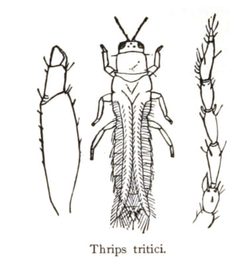
, the eastern , is one of the most abundant flower thrips in the eastern United States. It inhabits blossoms of wild and cultivated plants, including dandelion, and feeds by extracting nutrients directly from individual plant . Unlike several , it is not a of Tomato spotted wilt virus and is considered a pest of secondary economic importance. It can be difficult to distinguish from similar Frankliniella species without microscopic examination.
Pronunciation
How to pronounce Frankliniella tritici: //fɹæŋklɪˈnɪlə ˈtɹɪtɪˌsaɪ//
These audio files are automatically generated. While they are not always 100% accurate, they are a good starting point.
Identification
Microscopic examination is required for reliable identification from similar Frankliniella . It may be confused with Frankliniella bispinosa and Frankliniella occidentalis, both capable of Tomato spotted wilt virus. The species has strap-like wings edged with long hairs, a wing design that increases aerodynamic in very small arthropods.
Images
Habitat
Flowers of wild and cultivated plants; commonly found on dandelion blossoms and other blooming vegetation.
Distribution
Eastern United States, primarily east of the Rocky Mountains; also recorded from Canada, Japan, Kansas, Wisconsin, and parts of Brazil (Maranhão, Minas Gerais, Pernambuco, Piauí, Tocantins).
Diet
Extracts nutrients directly from individual plant ; pollen is a major food source. May also digest cells of fungi in leaf litter.
Ecological Role
Pest of secondary economic importance; not a of Tomato spotted wilt virus, unlike related Frankliniella . Serves as prey for minute pirate bugs (Orius spp.) and other . Subject to by the Thripinema fuscum.
Human Relevance
Directly damages plants, grasses, trees, and commercial crops through feeding and oviposition. Affects small fruit production including strawberries, grapes, blueberries, and blackberries; also impacts alfalfa, oats, beans, and asparagus. Considered a pest of secondary importance compared to virus-vectoring .
Similar Taxa
- Frankliniella occidentalisWestern flower thrips; capable of Tomato spotted wilt virus; distribution extends throughout the United States and Canada rather than being restricted east of the Rocky Mountains
- Frankliniella bispinosaCapable of Tomato spotted wilt virus; occurs in Florida and may be confused with F. tritici
- Frankliniella fuscaTobacco thrips; another with different associations and virus status
- Frankliniella vacciniiBlueberry ; another congeneric pest of small fruits
Misconceptions
Despite some sources claiming it tospoviruses, authoritative sources indicate is not a vector of Tomato spotted wilt virus and is considered a pest of secondary importance. The '' is often applied generically to numerous Frankliniella , causing confusion.
Sources and further reading
- BugGuide
- Wikipedia
- GBIF taxonomy match
- iNaturalist taxon
- NCBI Taxonomy
- Catalogue of Life
- Probing the Molecular Interactions Between Western Flower Thrips and the Tomato Spotted Wilt Virus | Bug Squad
- Addie Abrams, Ph.D to Be, to Present Exit Seminar | Bug Squad
- Addie Abrams Targeting Aphids and Thrips in California Lettuce | Bug Squad
- Outstanding Group of UC Davis Graduate Students at ESA Meeting | Bug Squad
- Bugs for All, All for Bugs | Bug Squad
- Life and death in a cone flower: Minute pirate bugs, Orius spp., and their prey, flower thrips, Frankliniella spp. — Bug of the Week
- Flower thrips, Frankliniella tritici (Fitch) (Insecta: Thysanoptera: Thripidae)
- Pest Information Guide: Eastern Flower Thrips Frankliniella tritici (Fitch)
- A Comparison of the Life Cycles of Frankliniella Tritici (Fitch), F. Fusca (Hinds) and Thrips Tabaci Lind. (Thysanoptera-Thripidae) in South Carolina
- Effects ofSoybean Vein Necrosis Viruson Life History and Host Preference of Its Vector,Neohydatothrips variabilis, and Evaluation of Vector Status ofFrankliniella triticiandFrankliniella fusca
- SEASONAL DISTRIBUTION OF THE FLOWER THRIPS (FRANKLINIELLA TRITICI (FITCH)) AND ONION THRIPS (THRIPS TABACI LINDEMAN) (THYSANOPTERA: THRIPIDAE) ON SAFFLOWER IN EASTERN MONTANA