
Caenocholax fenyesi
Pierce, 1909
Caenocholax fenyesi is a strepsipteran in the Myrmecolacidae, notable for extreme and heterotrophic heteronomy—males and females occupy different throughout their . Females are of Orthoptera, while males parasitize larvae and pupae, primarily Solenopsis invicta (red imported fire ant) in the United States and related native fire ants in Mexico, Central America, and parts of South America. The has a sporadic distribution across the southern United States, Central America, and South America, with three recognized cryptic that are morphologically similar but genetically distinct. males are free-living with a lifespan of only hours to a few days, severely constraining and contributing to genetic bottlenecking effects.
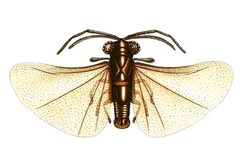
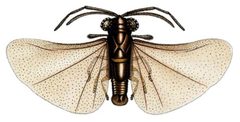
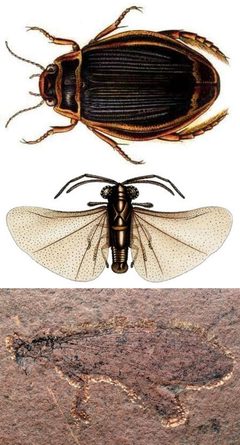
Pronunciation
How to pronounce Caenocholax fenyesi: //ˌsiːnoʊˈkoʊlæks ˈfɛn.jɛsi//
These audio files are automatically generated. While they are not always 100% accurate, they are a good starting point.
Identification
males distinguished from other Strepsiptera by combination of: short forewings and large fan-like hindwings with reduced venation; 15–150 in ; specific leg including lack of on fore and midlegs, 2–5 tarsal segments, and enlarged hind tibia and ; positioned on ninth abdominal segment. Females identified by: complete absence of wings, , , mouthparts, legs, and external genitalia; cephalothoracic structure with canal opening; association with Orthoptera. First instar larvae identified by: 70–80 μm size, brown color, sclerotized with specific serration patterns, adhesive tarsal pads, three pits, three ocelli, and 40 μm caudal filaments on segment 10. Cryptic (fenyesi fenyesi, texensis, waloffi) require genetic analysis for definitive identification. Distinguished from Caenocholax brasiliensis (the only other named in ) by geographic distribution and host associations.
Images
Habitat
determined by intersection of ranges: females occur in habitats supporting Orthoptera (grasshoppers, crickets, katydids); males occur in habitats supporting their hosts, particularly Solenopsis invicta and related fire ants. Males and their ant hosts are less common in grassland habitats. Local persistence depends on proximity of both host types; is severely constrained by male short lifespan, poorly developed , and ant host nesting .
Distribution
Sporadic distribution throughout North America, Central America, and South America. United States: Florida, Louisiana (New Orleans, southern and central regions), Mississippi, Georgia, Arizona, Alabama, and Texas. Neotropics: Córdoba and Tabasco, Mexico; Petén, Guatemala; Matagalpa, Nicaragua; Rica; Panama; Ecuador; Chile; Misiones, Argentina; Andros Island, Bahamas; and Cuba. Three cryptic with partially overlapping ranges: C. f. fenyesi, C. f. texensis, and C. f. waloffi.
Host Associations
- Orthoptera - of femalesFemales are throughout their entire lifecycle; specific orthopteran not documented in available sources
- Solenopsis invicta - of male larvae and pupaeRed imported fire ant; primary for males in United States; male larvae are , are free-living
- Native fire ants related to Solenopsis invicta - of male larvae and pupae switch documented in Arizona, Mexico, Central America, and parts of South America; represents original host association prior to S. invicta introduction
- Camponotus planatus - of male larvae and pupaeDocumented in Mexico; questioned as potential original host in published source
- Ant (Formicidae) - of male larvae and pupaeNew record from Rica; specific not identified in available source
Life Cycle
Females lack pupal instar; float freely in haemolymph; produce up to 750,000 embryos; by haemocoelic insemination; by haemocoelous viviparity; motile first instar larvae released through canal opening in . First instar larvae free-living, short-lived, function is location; upon finding host undergo , bore through , moult to second instar. Male development: second instar (sex determinable), third instar (three pairs of , bulbous ), (prefrontal and complex /wings develop), pupa (wings and genitalia reach full size), subimago (wings in ), ( of all previous cuticles, wings inflated, muscles developed, sperm matured). Males emerge from host as . Female development: second instar (rounded 'head', tapering ), tertiary larval stages endoparasitic without ecdysis. Endoparasitic larval stages experience without ecdysis.
Behavior
Males exhibit choosy mate selection, rejecting females carrying embryos at advanced developmental stages; unsuccessful courtship stimulation results in female rejection. Courtship involves male striking female's with ; copulation lasts up to one minute and may occur multiple times before male seeks additional females. Females release sex to attract males. First instar larvae disperse by traveling with foraging ants to reach colonies for parasitization of larvae and pupae. Parasitized Solenopsis invicta exhibit altered : climb to high perches, assume flagging posture, and remain stationary until . males immediately begin flying and searching for females upon emergence; adult lifespan typically hours, occasionally up to few days. Poorly developed and short lifespan severely constrain male .
Ecological Role
Koinobiont : continues development after parasitization; host lifespan extended to allow male maturation and female larval release synchronized with next host . As parasitoid of Solenopsis invicta, functions as potential agent. Genetic bottlenecking observed due to restricted larval and small local , creating extinction risk but also potential for new population establishment via rare long-distance dispersal events.
Human Relevance
Investigated as potential agent for red imported fire ant (Solenopsis invicta) in United States and Australia; parasitization rate currently too low for reliable control. Chemical remain primary management tool for S. invicta; C. fenyesi offers alternative approach given 's lack of natural enemies in introduced North American range. More research required to assess feasibility as biocontrol agent.
Similar Taxa
- Caenocholax brasiliensisOnly other named in Caenocholax; distinguished by geographic distribution and associations
- Other Myrmecolacidae members share heteronomous with sexes on different ; C. fenyesi distinguished by specific host associations with Solenopsis invicta and Orthoptera, and by male genitalic and wing
- Other StrepsipteraOrder-level shared traits of extreme and endoparasitism; Myrmecolacidae distinguished by -orthopteran dichotomy versus other families with different host patterns (e.g., Stylopidae on bees/, Halictophagidae on leafhoppers)
More Details
Subspecies
Three cryptic recognized, morphologically similar but genetically distinct: Caenocholax fenyesi fenyesi Pierce, 1909; Caenocholax fenyesi texensis Kathirithamby & Johnston, 2004; Caenocholax fenyesi waloffi Kathirithamby & Johnston, 2004. Genetic divergence over large distances contributes to bottlenecking effects.
Host Switch Evolution
Original hypothesized to be black fire (Solenopsis richteri) in Mesoamerica; host switch to red imported fire ant (S. invicta) occurred in southern United States following ant's introduction in early 1900s. Males in Arizona, Mexico, Central America, and parts of South America retain of native fire ants closely related to S. invicta.
Virulence Patterns
Highly virulent in ; not virulent in larval ant hosts due to slower growth rate in larval stages. Each host occupied by single individual.
Sensory Exploitation
occurs via sensory exploitation: females are not choosy, males are choosy; male tarsal striking of female during courtship serves stimulatory function; only female contacted during insemination.
Sources and further reading
- BugGuide
- Wikipedia
- GBIF taxonomy match
- iNaturalist taxon
- NCBI Taxonomy
- Catalogue of Life
- New Host Association, Distribution, and Morphological Variation in Caenocholax fenyesi (Strepsiptera: Myrmecolacidae)
- New host record for Caenocholax fenyesi sensu lato (Strepsiptera: Myrmecolacidae) from Costa Rica
- Distribution of Caenocholax fenyesi (Strepsiptera: Myrmecolacidae) and the Habitats Most Likely To Contain Its Stylopized Host, Solenopsis invicta (Hymenoptera: Formicidae)
- <I>Caenocholax fenyesi</I> (Strepsiptera: Myrmecolacidae) Parasitic in <I>Camponotus planatus</I> (Hymenoptera: Formicidae) in Mexico: Is This the Original Host?