
Caenocholax
Pierce, 1909
Species Guides
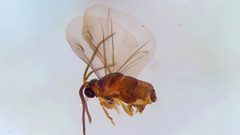
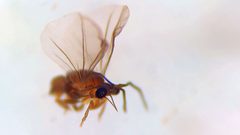
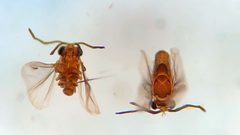
1Caenocholax is a of twisted-winged insects (Strepsiptera) in the Myrmecolacidae, comprising approximately nine described . Members are endoparasitoids of ants, with documented associations including Solenopsis invicta and Camponotus planatus. The genus exhibits the extreme characteristic of Strepsiptera: males are free-living with reduced forewings and large fan-shaped hindwings, while females remain endoparasitic and neotenic within the .
Pronunciation
How to pronounce Caenocholax: /keɪnoʊˈkoʊlæks/
These audio files are automatically generated. While they are not always 100% accurate, they are a good starting point.
Identification
Males are distinguished by the strepsipteran wing arrangement—forewings modified into small club-like and large, fan-shaped hindwings with reduced venation. Females are not free-living; they occur as endoparasitic forms protruding from the , with only the visible externally. Specific identification of Caenocholax requires examination of male genitalia and other microscopic characters; the is distinguished from related myrmecolacid genera by details of antennal structure and genital .
Images
Habitat
are determined by distribution. For Caenocholax fenyesi, stylopized host colonies occur most frequently in open, disturbed areas with sparse vegetation and high soil moisture, particularly low-lying, poorly drained areas near bodies of water or in flood-prone zones.
Distribution
Documented from the southeastern United States (associated with Solenopsis invicta), Mexico (associated with Camponotus planatus), Rica, and Brazil. The likely occurs wherever suitable ants are present within the Neotropical and Nearctic regions.
Host Associations
- Solenopsis invicta - primary red imported fire ant; most extensively documented for C. fenyesi
- Camponotus planatus - documented for C. fenyesi in Mexico; may represent original host association
Life Cycle
First-instar larvae (triungulins) are free-living and actively seek ants. Upon locating a host, they penetrate the and develop as . Females remain within the host throughout life, becoming neotenic and sac-like, with only the emerging from the host to release triungulins. Males pupate within the host, then emerge as free-living to seek females. Stylopization typically results in host castration.
Behavior
Stylopized exhibit modified , remaining inside the nest rather than foraging, and may aggregate near the colony center. This behavioral manipulation likely benefits by keeping parasitized hosts in protected nest locations.
Ecological Role
Acts as a agent, with potential to regulate of pest ants such as Solenopsis invicta. Population-level impacts on colonies remain under investigation.
Human Relevance
Studied as a potential agent for the red imported fire ant (Solenopsis invicta), a major pest in the United States.
Similar Taxa
- MyrmecolaxAlso in Myrmecolacidae; distinguished by male genitalia and antennal , though definitive separation requires expert examination
- other Strepsiptera generaCaenocholax is distinguished by association with ants (Formicidae) and -level characters of Myrmecolacidae; other families parasitize different host groups such as bees, , or leafhoppers
Sources and further reading
- BugGuide
- Wikipedia
- GBIF taxonomy match
- iNaturalist taxon
- NCBI Taxonomy
- Catalogue of Life
- New host record for Caenocholax fenyesi sensu lato (Strepsiptera: Myrmecolacidae) from Costa Rica
- New Host Association, Distribution, and Morphological Variation in Caenocholax fenyesi (Strepsiptera: Myrmecolacidae)
- Distribution of Caenocholax fenyesi (Strepsiptera: Myrmecolacidae) and the Habitats Most Likely To Contain Its Stylopized Host, Solenopsis invicta (Hymenoptera: Formicidae)
- <I>Caenocholax fenyesi</I> (Strepsiptera: Myrmecolacidae) Parasitic in <I>Camponotus planatus</I> (Hymenoptera: Formicidae) in Mexico: Is This the Original Host?