
Echidnophaga gallinacea
(Westwood, 1875)
hen flea, sticktight flea, stickfast flea
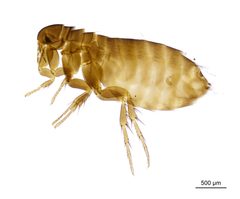
Echidnophaga gallinacea is a small, dark brown that parasitizes a broad range of bird and mammal including poultry, dogs, cats, and occasionally humans. females embed permanently into host skin—typically on bare areas of the and —using a serrated mouthpart to feed on blood, while males remain mobile. Heavy cause ulceration, dermatitis, anemia, and can be fatal to young or small hosts. The has spread globally through poultry farming and is now established across tropical, subtropical, and temperate regions.
Pronunciation
How to pronounce Echidnophaga gallinacea: /ɛˌkɪdnəˈfaɡə ˌɡælɪˈneɪʃə/
These audio files are automatically generated. While they are not always 100% accurate, they are a good starting point.
Identification
Approximately 2 mm in length, roughly half the size of the cat flea (Ctenocephalides felis). Dark brown coloration. Body flattened laterally. is angular or squarish in shape. Lacks both pronotal and genal ctenidia (combs)—a key distinguishing feature from Ctenocephalides . Two hairs present behind the . Hind legs enlarged with pads for jumping. Female possesses elongated, serrated mouthparts adapted for permanent attachment.
Images
Habitat
Associated with poultry housing, particularly free-range, rural, and backyard farming operations. Larval development requires organic matter such as soil, litter, bedding, or accumulated . Can establish in cracks in wooden floors, between cages, and in nest materials. In natural settings, found in areas where wild birds contact domestic poultry, including marshlands and nature reserves.
Distribution
distribution spanning tropical, subtropical, and temperate zones. Documented in North America, South America (Mexico), Europe, Asia (Saudi Arabia, Thailand, China, Japan), Australia, and the Seychelles (Aldabra Atoll). Range continues to expand with commercial poultry farming.
Diet
are obligate hematophages, feeding on blood from avian and mammalian . Larvae feed on organic debris including host and shed skin in the environment.
Host Associations
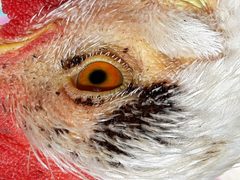
- Gallus gallus domesticus (domestic chicken) - primary females attach to comb, wattles, and around ; major economic pest
- Canis lupus familiaris (domestic dog) -
- Felis catus (domestic cat) -
- Homo sapiens (human) - occasional
- Athene cunicularia (Burrowing Owl) - wild novel record from Baja California Sur, Mexico
- Aphelocoma coerulescens (Florida Scrub-Jay) - wild
- Goura victoria (Victoria Crowned Pigeon) - captive
- Rattus spp. (rats) -
Life Cycle
Complete with four stages: , larva, pupa, and . Females shed eggs at night into skin ulcers or onto the ground; eggs are physically shaped to fall into cracks and crevices. Larvae pass through three instars, feeding on organic matter while negatively phototactic and positively geotropic, burrowing into soil or substrate. Third-instar larvae spin loose, sticky cocoons incorporating environmental debris for concealment. Pupae can remain for months; adults emerge in days under favorable conditions. Newly emerged adults survive 5–8 days without a before requiring a blood meal. Only approximately 5% of the exists as adults at any time.
Behavior
Females embed permanently into skin using serrated mouthparts, becoming for life after initial attachment and mating. Males remain mobile throughout life and seek out embedded females for mating. locate hosts using movement, body heat, and carbon dioxide cues. Females prefer bare skin areas; on poultry they attach to the , comb, wattles, and , migrating to under wings, breast, and cloaca during cold periods.
Ecological Role
and potential . Has been observed to carry and Bartonella. Associated with transmission dynamics through associations with Burrowing Owls. Can impact threatened bird through direct .
Human Relevance
Significant pest of poultry causing economic losses through reduced production, weight gain suppression, and mortality. Control relies on integrated management: concrete flooring to interrupt larval development, manual removal with tweezers, petroleum jelly to suffocate embedded , (maldison, pyrethrins), and environmental including burning of infested bedding. in dust baths shows promise for control in cage-free systems. Human require manual removal; antihistamines and topical steroids treat .
Similar Taxa
- Ctenocephalides felis (cat flea)Lacks the combs (ctenidia) present on and pronotum of cat flea; approximately half the size; females permanently attach rather than remaining mobile
- Ctenocephalides canis (dog flea)Similar to cat flea in possessing combs; E. gallinacea distinguished by absence of combs and permanent female attachment
- Pulex irritans (human flea)Lacks combs but differs in preference and female ; E. gallinacea females embed permanently while P. irritans females remain mobile
Sources and further reading
- BugGuide
- Wikipedia
- GBIF taxonomy match
- iNaturalist taxon
- NCBI Taxonomy
- Catalogue of Life
- Dust Baths and Longer Beaks Can Make Cage-free Chickens into Mite-free Chickens
- Backyard Chickens May Have Mites, Lice and Fleas
- Echidnophaga-gallinacea - Entomology Today
- Backyard Chickens Harbor Greater Diversity of Mites and Lice than Farm-raised Chickens
- Echidnophaga gallinacaea Archives - Entomology Today
- Sticktight Flea, Echidnophaga gallinacea
- Beyond the last frontier: Echidnophaga gallinacea (Siphonaptera: Pulicidae) infestation in a Burrowing Owl, a novel southward host in Mexico
- Genetic identification of the sticktight flea Echidnophaga gallinacea (Westwood) infesting chickens in the Al-Baha region, Saudi Arabia