
Lepinotus reticulatus
Enderlein, 1904
reticulate-winged trogiid, reticulate-winged booklouse, granary booklouse
Lepinotus reticulatus is a of granary booklouse in the Trogiidae. It is one of the most widely distributed , occurring across six continents in association with stored grain and dry organic materials. The species is frequently encountered in anthropogenic environments, particularly granaries, warehouses, and food storage facilities. Its refers to the distinctive reticulate wing venation pattern visible in winged morphs.
Pronunciation
How to pronounce Lepinotus reticulatus: //ˌlɛpɪˈnoʊtəs ˌrɛtɪkjuˈleɪtəs//
These audio files are automatically generated. While they are not always 100% accurate, they are a good starting point.
Identification
Distinguished from other Lepinotus and trogiids by the characteristic reticulate wing venation pattern. In wingless or reduced-wing morphs, identification requires examination of genitalic structures and subtle body proportions. The species' association with stored grain products and its distribution in human-modified environments are contextual clues supporting identification.
Images
Appearance
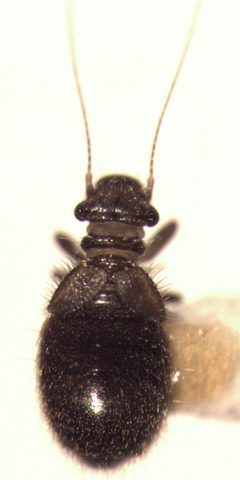
Small, soft-bodied insect with a somewhat flattened profile. Winged individuals possess membranous wings with a distinctive reticulate (net-like) venation pattern that gives the its . Body coloration ranges from pale yellowish to brownish. are long and . The species exhibits wing dimorphism, with both fully winged and reduced-wing or wingless morphs known.
Habitat
Primarily associated with stored grain, dry food products, and organic debris in anthropogenic environments. Occurs in granaries, warehouses, mills, and domestic food storage areas. Also found in natural situations including bird and mammal nests, where it feeds on shed skin fragments, feathers, and other dry organic matter.
Distribution
distribution spanning Africa, Australia, Europe and Northern Asia (excluding China), Central America, North America, Oceania, South America, and Southern Asia. Specific country records include: Afghanistan, Algeria, Angola, Armenia, Australia, Austria, Belarus, Belgium, Canada, Canary Islands, Chile, Cyprus, Czech Republic, Egypt, Finland, France, Germany, Great Britain, Greece, Hungary, Israel, Italy, Japan, Korea, Luxembourg, Mexico, Morocco, Mozambique, Netherlands, New Zealand, Poland, Portugal, Romania, Spain, Switzerland, Turkey, USA, and former Yugoslavia.
Diet
Feeds on dry organic matter including stored grain, cereal products, detritus, shed skin fragments, and feathers. Has been observed in association with bird and mammal nests where it consumes available organic debris.
Host Associations
- stored grain and cereal products - feeding substrateprimary anthropogenic
- bird nests - and food sourcefeeds on feathers and organic debris
- mammal nests - and food sourcefeeds on shed skin and organic matter
Ecological Role
Decomposer and in both natural and anthropogenic environments. In stored grain facilities, functions as a minor pest that contributes to the degradation of dry organic materials.
Human Relevance
Considered a minor pest of stored grain and dry food products. Its presence in granaries and warehouses can indicate conditions favorable to more economically significant stored product pests. Not known to cause direct damage to intact grain kernels but contributes to and quality degradation of stored products. Frequently used as an in stored product entomology surveys.
Similar Taxa
- Lepinotus patrueliscongeneric with overlapping distribution; requires examination of wing venation details and genitalic structures for separation
- Trogium pulsatoriumsympatric trogiid in stored product environments; distinguished by differences in wing venation and body proportions
- Psocoptera in family Liposcelididaesimilar preferences and appearance in stored product settings; distinguished by wing venation patterns and tarsal segmentation
More Details
Taxonomic Authorship
The was described by Enderlein in 1904. Some sources cite 1905, reflecting variation in publication dating conventions.
Wing Dimorphism
The exhibits both fully winged () and reduced-wing or wingless (brachypterous/) morphs. The reticulate wing pattern is diagnostic only in macropterous individuals.