
Trichadenotecnum alexanderae
Sommerman, 1948
common barklouse
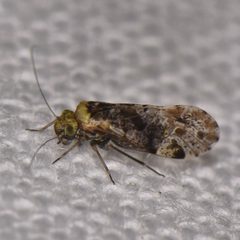
Trichadenotecnum alexanderae is a small, winged barklouse in the Psocidae. It belongs to a that includes three uniparental (T. castum, T. merum, and T. innuptum), all derived from the biparental T. alexanderae ancestor. The is notable for its facultative , though biparental is required for long-term persistence. It has been documented across eastern North America and is attracted to blacklights.
Pronunciation
How to pronounce Trichadenotecnum alexanderae: //ˌtrɪkəˌdɛnəˈtɛknəm ˌælɪgˈzændəˌraɪ//
These audio files are automatically generated. While they are not always 100% accurate, they are a good starting point.
Identification
Females of T. alexanderae can be distinguished from the three uniparental (T. castum, T. merum, T. innuptum) using morphological characters detailed in systematic keys. Males are present only in the biparental T. alexanderae; all-female collections typically represent one or more uniparental . The species may be confused with planthoppers or tiny at blacklights, but possesses chewing mouthparts rather than a beak or .
Images
Distribution
Eastern North America with a broad temperate- distribution across the region. Documented in the United States and Canada. Not restricted to relictual or peripheral portions of the range.
Seasonality
have been observed at blacklights in late October, suggesting fall activity.
Life Cycle
Facultative (thelytoky) can maintain a for only one ; biparental is required for continued population persistence.
Behavior
Males actively search for females and engage in stereotyped courtship involving contact, wing vibration, and specific positioning movements. Males persist with repeated courtship attempts if initially rejected. Copulation involves characteristic body positioning maintained during mating.
Human Relevance
Occasionally encountered by entomologists at blacklight surveys. No known economic or medical significance.
Similar Taxa
- Trichadenotecnum castumUniparental in the T. alexanderae complex; all-female require morphological examination to distinguish from T. alexanderae females
- Trichadenotecnum merumUniparental in the T. alexanderae complex; all-female require morphological examination to distinguish from T. alexanderae females
- Trichadenotecnum innuptumUniparental in the T. alexanderae complex; all-female require morphological examination to distinguish from T. alexanderae females
- Indiopsocus spp.Other common barklice that co-occur at blacklights and share general body plan
- Graphopsocus cruciatusNarrow barklouse that co-occurs at blacklights and may be mistaken for T. alexanderae
- Planthoppers (multiple families)Superficially similar at blacklights but possess piercing-sucking beaks rather than chewing mouthparts
- Tiny moths (Lepidoptera)May be mistaken for barklice at blacklights but possess scaled wings and a coiled
More Details
Species Complex and Parthenogenesis
T. alexanderae represents a remarkable case of speciation through shifts in reproductive mode. The biparental ancestor gave rise to three independently derived uniparental , each reproducing through obligate . This system provides a model for studying the evolutionary transition from sexual to .
Taxonomic Note
The name T. alexanderae was restricted to the biparental because the is male. This taxonomic decision was necessary to maintain nomenclatural stability while recognizing the biological diversity within the complex.
Sources and further reading
- BugGuide
- Wikipedia
- GBIF taxonomy match
- iNaturalist taxon
- NCBI Taxonomy
- Catalogue of Life
- Bug Eric: Last Night to Blacklight?
- The Biology of Trichadenotecnum Alexanderae Sommerman (Psocoptera:Psocidae). III. Analysis of Mating Behavior
- SYSTEMATICS OF THE TRICHADENOTECNUM ALEXANDERAE SPECIES COMPLEX (PSOCOPTERA: PSOCIDAE) BASED ON AN INVESTIGATION OF MODES OF REPRODUCTION AND MORPHOLOGY