
Trichadenotecnum
Enderlein, 1909
booklice, barklice
Species Guides
9- Trichadenotecnum alexanderae(common barklouse)
- Trichadenotecnum castum(common barklouse)
- Trichadenotecnum circularoides(common barklouse)
- Trichadenotecnum desolatum
- Trichadenotecnum majus(common barklouse)
- Trichadenotecnum merum(common barklouse)
- Trichadenotecnum pardus
- Trichadenotecnum quaesitum(common barklouse)
- Trichadenotecnum slossonae(common barklouse)
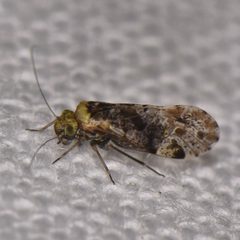
Trichadenotecnum is a large of barklice in the Psocidae, containing over 200 described . It is distinguished from related genera by forming a with highly variable genital , particularly in males. The genus exhibits diverse reproductive strategies, including both biparental and obligate or facultative (thelytoky) depending on the species.
Pronunciation
How to pronounce Trichadenotecnum: /ˌtrɪ.kəˌdɛnəˈtɛk.nəm/
These audio files are automatically generated. While they are not always 100% accurate, they are a good starting point.
Identification
within Trichadenotecnum are primarily distinguished by male genitalia , which is the most important diagnostic structure. Some males possess distinctly asymmetrical genitalia. The is well separated from related genera, forming a supported by genital morphology. Forewing spotted patterns are variable but not definitive for species identification.
Images
Habitat
Temperate and regions; specific microhabitats include surfaces where pleurococcine occur.
Distribution
distribution throughout most of the world. Absent from Australia and New Zealand, which have no native . Documented from eastern North America, southeastern United States, Borneo, Brazil (West-central and Southeast), Guatemala, and Honduras.
Diet
Feeds on pleurococcine (documented for T. alexanderae); specific diet for most not established.
Life Cycle
Includes , nymphal, and stages. stages documented for at least T. circularoides.
Behavior
Mating involves specific courtship sequences and copulation patterns (documented for T. alexanderae). Some reproduce via obligate , producing all-female .
Ecological Role
Algivore; contributes to nutrient cycling through consumption of on bark and other surfaces.
Human Relevance
No direct economic or medical significance documented. Occasionally encountered in ecological and systematic studies due to complex reproductive and .
Similar Taxa
- Related psocid generaTrichadenotecnum is well separated from related by forming a distinct ; distinguished primarily by genital and reproductive
More Details
Reproductive Diversity
The exhibits exceptional reproductive diversity. T. alexanderae is biparental with facultative (can maintain through one only via ). Three uniparental (T. castum, T. merum, T. innuptum) reproduce via obligate thelytokous parthenogenesis. This system has been used as a model for studying the evolution of parthenogenesis and .
Systematic Importance
The large is divided into several clades and subclades based primarily on genital . This structure makes Trichadenotecnum significant for studies of morphological evolution and speciation in .
Sources and further reading
- BugGuide
- Wikipedia
- GBIF taxonomy match
- iNaturalist taxon
- NCBI Taxonomy
- Catalogue of Life
- The Biology of Trichadenotecnum Alexanderae Sommerman (Psocoptera:Psocidae). III. Analysis of Mating Behavior
- Trichadenotecnum circularoides (Psocoptera: Psocidae) in Southeastern United States, with Notes on Its Reproduction and Immature Stages
- SYSTEMATICS OF THE TRICHADENOTECNUM ALEXANDERAE SPECIES COMPLEX (PSOCOPTERA: PSOCIDAE) BASED ON AN INVESTIGATION OF MODES OF REPRODUCTION AND MORPHOLOGY