
Psocidae
Hagen, 1865
Common Barklice
Subfamily Guides
2- Amphigerontiinae
- Psocinae(common barklice)
is a of barklice in the order Psocodea, distinguished by diagnostic wing venation where the areola postica is to the M-, forming a discoidal . The family contains approximately 86 and is widespread globally, with documented diversity in East Africa, Southeast Asia, Melanesia, and the Americas. Psocidae is closely related to Myopsocidae. Many are arboreal, though specific ecological roles remain understudied.
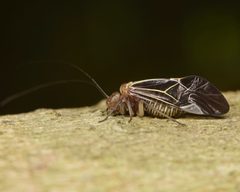
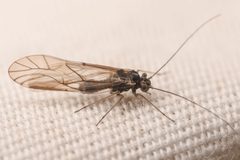
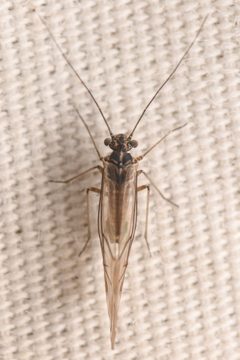
Pronunciation
How to pronounce Psocidae: //ˈsəʊ.sɪ.diː//
These audio files are automatically generated. While they are not always 100% accurate, they are a good starting point.
Identification
Diagnostic wing venation separates from related : the areola postica is to the M-, producing a discoidal . This contrasts with families such as Myopsocidae where this fusion does not occur. Identification to and level requires examination of genitalic structures and detailed wing venation patterns; regional keys are available for East Africa, Indonesia, and China.
Images
Appearance
Members of are small, soft-bodied insects. Winged forms possess characteristic wing venation: the areola postica is to the M-, creating a discoidal —a diagnostic feature for the . Body form typical of barklice, with broad and chewing mouthparts.
Habitat
Primarily arboreal; have been recorded from forest and vegetation surfaces. Specific microhabitat preferences vary by species and remain incompletely documented.
Distribution
Widespread globally. Documented from: East Africa, Sumatra and eastern Indonesia (Java, Lesser Sunda Islands, Bali, Lombok), New Guinea and Melanesian arc islands, China, New Zealand, southeastern United States, and the Caribbean (Bahamas). GBIF records indicate presence in Brazil (West-central, Northeast, Southeast) and Borneo.
Human Relevance
No documented direct economic or medical significance. Some in related psocopteran groups are minor stored-product pests, but specific human relevance for is not established in available sources.
Similar Taxa
- MyopsocidaeClosely related distinguished by wing venation: Myopsocidae lack the fusion of areola postica to M- that characterizes
- PeripsocidaeCo-occurring psocopteran in many regions; separated by wing venation patterns and genitalic , with regional keys available for differentiation
More Details
Taxonomic diversity
The contains 86 recognized . Recent taxonomic work has described numerous new from underexplored regions, including 42 new species from Java and eastern Indonesia, 10 new species from Melanesia, and multiple new species from China.
Biogeographic patterns
Distribution patterns in Melanesia suggest complex origins including tectonic fragmentation, from New Guinea, and potential dispersal from Hawaii or Micronesia.
Sources and further reading
- BugGuide
- Wikipedia
- GBIF taxonomy match
- iNaturalist taxon
- NCBI Taxonomy
- Catalogue of Life
- Records of Psocidae: Psocinae (Insecta: Psocoptera) from Sumatra, Indonesia
- The Peripsocidae and Psocidae (Psocoptera) of East Africa
- Forms, Distribution, and Relationships of 'Psocus' coquilletti Banks (Psocoptera: Psocidae)
- Symbiopsocus Li (Psocoptera: Psocidae), with a new species from China
- Systematics and distribution of the Melanesian Psocidae (Psocoptera)
- The genus Sigmatoneura Enderlein (Psocoptera: Psocidae), with two new species from China LUXI LIU, FASHENG LI & ZHIQI LIU
- The Psocidae (Insecta : Psocoptera) of Java and the eastern islands of Indonesia
- Trichadenotecnum circularoides (Psocoptera: Psocidae) in Southeastern United States, with Notes on Its Reproduction and Immature Stages