
Graphopsocus cruciatus
(Linnaeus, 1768)
F-winged Barklouse
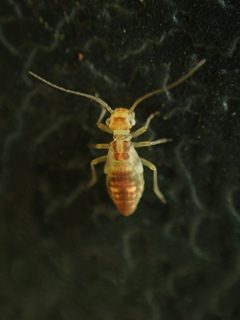
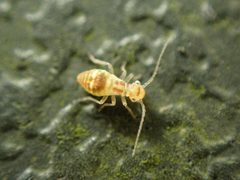
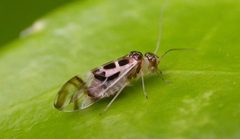
Graphopsocus cruciatus, commonly known as the F-winged Barklouse, is a of barklouse in the Stenopsocidae. Native to Europe and parts of Asia, it was introduced to North America around 1930 and has since established across the continent. This small insect is notable for its distinctive wing pattern featuring five dark marks on the half and a light "F"-shaped mark on the half. It is frequently observed on building exteriors and vegetation, where it feeds on microflora.
Pronunciation
How to pronounce Graphopsocus cruciatus: /græˌfoʊpˈsoʊkəs kruːsiˈeɪtəs/
These audio files are automatically generated. While they are not always 100% accurate, they are a good starting point.
Identification
Distinguished from other barklice by the unique wing pattern: five dark spots on the forewing base and a pale, F-shaped marking distally. The narrow wing shape separates it from broader-winged barklice in like Psocidae. From planthoppers (Hemiptera), it differs in having chewing mouthparts rather than a piercing-sucking beak, and from small in lacking scaled wings.
Images
Habitat
Found on exterior surfaces of buildings, fences, and vegetation. Associated with microflora growth on plant leaves and artificial surfaces. In North America, often observed in residential and suburban settings.
Distribution
Native to Europe, northern Africa, and parts of Asia including China, Japan, and Mongolia. Introduced to North America around 1930; now established in Canada, USA, and Mexico. Also recorded from South America (Argentina, Brazil) and Africa (Angola, Zambia).
Seasonality
active year-round in mild climates, with increased observation in late fall. In temperate regions, adults overwinter and become active on warm winter days.
Diet
Feeds on microflora including , fungi, and lichens growing on plant leaves and other surfaces.
Life Cycle
with , nymph, and stages. Specific details of developmental timing and number of per year are not well documented.
Behavior
frequently observed roaming on building exteriors and fences. Gregarious tendencies not documented. capability present but specific undocumented.
Ecological Role
Contributes to decomposition and nutrient cycling through consumption of microflora. Serves as prey for various small including spiders and predatory insects.
Human Relevance
Non-pest ; does not damage structures, crops, or stored products. Presence on building exteriors is benign. Occasionally noticed by homeowners due to tendency to aggregate on walls and fences.
Similar Taxa
- Indiopsocus spp.Other common barklice, but broader-winged and lacking the distinctive F-shaped wing marking
- Trichadenotecnum spp.Common barklice with different wing venation and pattern, no F-shaped mark
- Planthoppers (Hemiptera)Similar size and hopping , but possess piercing-sucking beaks and different wing structure
More Details
Introduction History
The was first detected in North America in 1930, with origins traced to either Asia or Europe. It has since become one of the most commonly encountered introduced barklice in North America.
Observation Notes
Frequently one of the few barklice active during winter months in temperate regions, making it notable in seasonal insect surveys.