
Stenopsocidae
Pearman, 1936
Narrow Barklice
Genus Guides
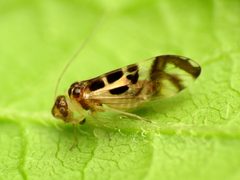
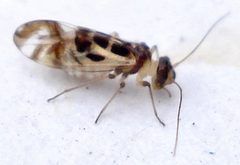
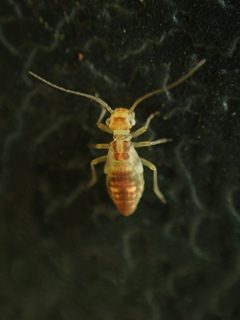
1is a of barklice in the suborder Psocomorpha, containing approximately 190 valid across four (Graphopsocus, Malostenopsocus, Neostenopsocus, Stenopsocus). The family is distinguished by wing venation featuring an areola postica connected to the M by a crossvein. Species exhibit considerable structural uniformity in external , with genitalia providing limited diagnostic value. The group shows exceptional diversity in East and Southeast Asia, particularly China.
Pronunciation
How to pronounce Stenopsocidae: /stɛˌnɒpˈsoʊsəˌdiː/
These audio files are automatically generated. While they are not always 100% accurate, they are a good starting point.
Identification
Distinguished from related by the areola postica connected to the M by a crossvein. Within the family, Neostenopsocus (established 2024 with 115 transferred ) is characterized by forewing with glabrous CuP, with styli, and with three vesicles. Marking patterns on the and forewings are considered useful for species-level identification. COI barcode (675 ) generally sufficient for species delimitation, with K2P interspecific distances mostly exceeding 0.10, though some closely related species require integrated approaches combining , geography, and nuclear .
Images
Habitat
Terrestrial , primarily associated with trees.
Distribution
Oriental, Palearctic, and Australian regions. Exceptionally rich in East and Southeast Asia, with highest documented diversity in China. GBIF records confirm presence in Laos, Taiwan, Vietnam, Denmark, and Norway.
Behavior
Free-living .
Ecological Role
Common in terrestrial ; specific ecological functions not documented.