
Amphigerontia contaminata
(Stephens, 1836)
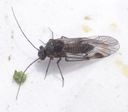
Amphigerontia contaminata is a barklouse in the Psocidae, found across Europe and parts of Asia and North America. are small, soft-bodied insects with either light black or brown coloration. The species has been recorded from numerous tree and shows a broad geographic distribution, though it is uncommon to scarce in parts of its British and Irish range.
Pronunciation
How to pronounce Amphigerontia contaminata: //ˌæm.fɪ.dʒɛˈrɒn.ti.ə ˌkɒn.tæ.məˈneɪ.tə//
These audio files are automatically generated. While they are not always 100% accurate, they are a good starting point.
Identification
Distinguished from similar Amphigerontia by genitalic characters (not visible without magnification). Coloration alone (light black or brown) is insufficient for reliable identification. Separation from other Psocidae requires examination of wing venation, antennal segment counts, and male clasping structures.
Images
Habitat
Occurs on bark and foliage of various broadleaf trees including apple (Malus), birch (Betula), elder (Sambucus), hawthorn (Crataegus), hazel (Corylus), oak (Quercus), and sea buckthorn (Hippophae).
Distribution
Native to Europe with records from Austria, Belgium, Bulgaria, Cyprus, Czech Republic, Finland, France, Germany, Greece, Hungary, Ireland, Italy, Latvia, Luxembourg, Netherlands, Norway, Poland, Romania, Spain, Sweden, Switzerland, and United Kingdom. Also recorded from Canary Islands, Turkey, Israel, Korea, Mongolia, and eastern Canada. GBIF records indicate presence in North America and northern Asia, though these may represent introductions or misidentifications requiring verification.
Host Associations
- Malus - apple trees
- Betula - birch
- Sambucus - elder
- Crataegus - hawthorn
- Corylus - hazel
- Quercus - oak
- Hippophae - sea buckthorn
Human Relevance
No documented economic or medical significance. Occasionally encountered by entomologists and naturalists during bark sampling or beating of broadleaf trees.
Similar Taxa
- Amphigerontia bifasciataOverlapping European distribution and similar bark-dwelling habit; requires genitalic examination for separation
- Psocidae speciesGeneral morphological similarity; accurate identification to / requires examination of wing venation and genitalia
More Details
Taxonomic note
placement has been inconsistent in literature: Wikipedia sources cite both Psocidae and Stenopsocidae, but current consensus (Catalogue of Life, NCBI) places this in Psocidae, Amphigerontiinae.
Distribution status
Considered uncommon in Britain and scarce in Ireland despite broad European distribution; this pattern may reflect collecting or genuine rarity in oceanic climates.