
Elipsocus hyalinus
(Stephens, 1836)
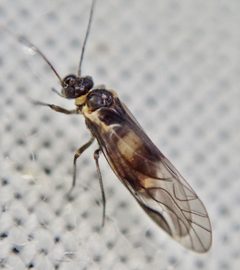
Elipsocus hyalinus is a of barklouse in the Elipsocidae, characterized by yellowish-black coloration. It is widely distributed across Europe, with additional records from North America, North Africa, and parts of Asia. The species feeds on diverse plant material including fruits, berries, and foliage of numerous tree and shrub species.
Pronunciation
How to pronounce Elipsocus hyalinus: /ɛlɪpˈsɔkəs haɪˈalɪnəs/
These audio files are automatically generated. While they are not always 100% accurate, they are a good starting point.
Identification
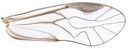
Distinguished from similar Elipsocus by coloration and genitalia characteristics; precise identification requires microscopic examination of wing venation and male parameres. The yellowish-black color pattern separates it from some , though reliable determination typically requires taxonomic keys.
Images
Appearance
Yellowish-black coloration. As a member of Psocodea, possess two pairs of membranous wings with reduced venation, long , and soft bodies. Specific morphological details distinguishing this from are not documented in available sources.
Habitat
Associated with woody vegetation including trees and shrubs. Documented feeding on foliage and reproductive structures of numerous plant across varied .
Distribution
Europe: Great Britain, Ireland, Austria, Belgium, Cyprus, Denmark, Finland, France, Germany, Greece, Hungary, Italy, Luxembourg, Netherlands, Norway, Poland, Portugal, Romania, Spain, Sweden, Switzerland; also recorded from Czechoslovakia, Yugoslavia, USSR (historical). North Africa: Algeria, Morocco, Israel. North America: USA. Asia: Mongolia.
Diet
Feeds on fruits and berries including horse chestnut (Aesculus hippocastanum), plum (Prunus), rowan (Sorbus aucuparia), snowberry (Symphoricarpos), and wayfaring tree (Viburnum ). Also consumes foliage from trees: alder (Alnus), ash (Fraxinus), beech (Fagus), birch (Betula), blackthorn (Prunus spinosa), broom (Cytisus), Chinese juniper (Juniperus chinensis), elder (Sambucus), hawthorn (Crataegus), hazel (Corylus), ivy (Hedera), juniper (Juniperus), larch (Larix), oak (Quercus), pine (Pinus), sycamore (Acer pseudoplatanus), sea buckthorn (Hippophae), spruce (Picea), turkey oak (Quercus cerris), and willow (Salix).
Ecological Role
and phytophage contributing to nutrient cycling in forest and shrubland . Feeding on surface material of plants places it within the guild of micro-decomposers and surface-feeding psocopterans.
Human Relevance
No documented economic or medical significance. Occasionally encountered in entomological surveys and biodiversity assessments.
Similar Taxa
- Other Elipsocus species share similar body plan and preferences; require examination of genitalia and wing venation for definitive separation.
- Other Elipsocidae members occupy similar on vegetation; identification to level requires knowledge of psocopteran .
More Details
Taxonomic Note
The was described by Stephens in 1836. The Elipsocidae is placed in the infraorder Homilopsocidea within Psocomorpha. The Elipsocus contains multiple species with overlapping distributions in Europe, necessitating careful morphological examination for accurate identification.
Feeding Ecology
The broad dietary breadth across diverse angiosperm and gymnosperm suggests a feeding strategy rather than specialized host associations. This dietary flexibility likely contributes to its wide geographic distribution.