
Homilopsocidea
Pearman, 1936
barklice, booklice
Family Guides
9- Archipsocidae(Ancient Barklice)
- Ectopsocidae(Outer Barklice)
- Elipsocidae(Damp Barklice)
- Lachesillidae(Fateful Barklice)
- Mesopsocidae(Middle Barklice)
- Peripsocidae(Stout Barklice)
- Philotarsidae(Loving Barklice)
- Pseudocaeciliidae(False Lizard Barklice)
- Trichopsocidae(Lash-faced Barklice)
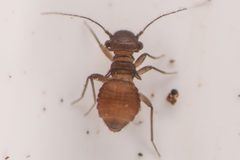
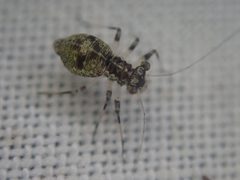
Homilopsocidea is an infraorder of Psocodea (formerly ) containing approximately 7 and over 1,200 described . It is widely regarded as a group that remains in use pending taxonomic revision. The infraorder includes barklice and booklice found in diverse terrestrial . Families within Homilopsocidea are distinguished by ecological preferences and morphological traits rather than by clear phylogenetic relationships.

Pronunciation
How to pronounce Homilopsocidea: //ˌhɒmɪloʊˈsɒsɪˌdiːə//
These audio files are automatically generated. While they are not always 100% accurate, they are a good starting point.
Identification
Homilopsocidea encompasses that are distinguished from other psocodean infraorders primarily by combinations of wing venation patterns, tarsal segmentation, and genitalic structures. Specific identification to family level requires examination of wing shape, presence or absence of areola postica in the forewing, and details of the hypandrium and phallosome in males. The families Ectopsocidae, Elipsocidae, Lachesillidae, Mesopsocidae, and Peripsocidae are the most -rich and can be separated by association and subtle morphological differences in and mouthparts.
Images
Habitat
Members occupy diverse microhabitats including bark of living and dead trees, leaf litter, rock surfaces, and human structures. Ectopsocidae (outer barklice) are found on tree bark; Elipsocidae (damp barklice) prefer moist environments; Lachesillidae occupy varied terrestrial ; Mesopsocidae (middle barklice) inhabit bark and foliage; Peripsocidae (stout barklice) occur on bark and leaves; Lesneiidae and Sabulopsocidae have more restricted, specialized habitats.
Distribution
Worldwide distribution across terrestrial , with greatest diversity in tropical and temperate regions. Individual show varying geographic ranges: Ectopsocidae and Lachesillidae are ; Peripsocidae are widespread but more diverse in the Old World; Mesopsocidae are primarily Holarctic with some tropical representation; Elipsocidae are predominantly temperate; Lesneiidae and Sabulopsocidae have more limited, patchy distributions.
Diet
Feeding habits are presumed similar to other Psocomorpha: grazing on microflora including lichens, , fungal spores, and organic detritus. Specific dietary data for the infraorder as a whole are not established.
Ecological Role
As primary consumers of microflora and detritus, members contribute to nutrient cycling and decomposition in forest and woodland . They serve as prey for small and may facilitate spore of fungi and lichens.
Human Relevance
Some occasionally occur in stored products and buildings, where they are minor nuisance pests. They do not bite humans or transmit . Presence in homes may indicate high humidity conditions.
Similar Taxa
- TrogiomorphaAnother infraorder of Psocodea; distinguished by different wing venation patterns and generally more reduced wing in many
- PsocetaeThird infraorder of Psocodea; typically characterized by distinct capsule and different arrangement of thoracic
More Details
Taxonomic Status
Homilopsocidea is explicitly recognized as likely in current literature. Molecular phylogenetic studies have repeatedly failed to recover it as monophyletic, suggesting that currently assigned to this infraorder may be more closely related to members of other infraorders than to each other. The group persists in formal use because no revised classification has achieved consensus.
Family Composition
The seven recognized are Ectopsocidae, Elipsocidae, Lachesillidae, Lesneiidae, Mesopsocidae, Peripsocidae, and Sabulopsocidae. Lesneiidae and Sabulopsocidae were established relatively recently (2004) and remain poorly known compared to the other families.