
Trogiomorpha
Roesler, 1940
Infraorder Guides
2is one of three suborders of Psocodea (barklice, booklice, and parasitic lice), alongside Troctomorpha and Psocomorpha. It is widely agreed to be the earliest diverging of the three suborders and retains the most primitive characteristics. The suborder contains approximately eight and more than 430 described extant , though it is currently the least diverse suborder. Trogiomorpha comprises the majority of Cretaceous psocodean species described to date, suggesting it was more diverse in the past.
Pronunciation
How to pronounce Trogiomorpha: //ˌtroʊ.dʒiː.oʊˈmɔːr.fə//
These audio files are automatically generated. While they are not always 100% accurate, they are a good starting point.
Identification
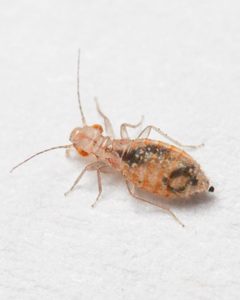
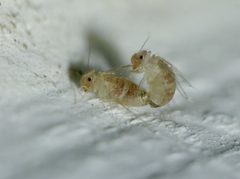
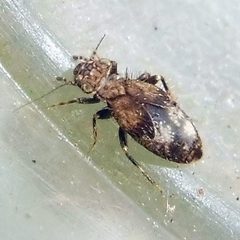
Distinguished from other Psocodea suborders by the combination of: with 20+ segments (vs. fewer in Troctomorpha and Psocomorpha), three equal tarsal segments (vs. two in Psocomorpha), and presence of a strong abdominal spine. The 'mothlike' brown appearance contrasts with the generally more varied coloration of Psocomorpha.
Images
Appearance
possess with 20 or more flagellomeres (segments). are three-segmented with segments of approximately equal length. A strong spine is present on the . Coloration has been described as 'mothlike' and brown.
Habitat
Extant occupy diverse including caves (Psyllipsocidae), bird nests (Psoquillidae), and granaries (Trogiidae). Some species occur in domestic environments. Fossil evidence suggests Cretaceous trogiomorphans inhabited forest environments preserved in amber deposits.
Distribution
Extant occur globally across multiple biogeographic realms including West Palaearctic, Afrotropical, Australian, Nearctic, Neotropical, and Oriental realms. Fossil record extends from Early Cretaceous to Eocene, with specimens from Spanish, French (Charentese), and Myanmar (Burmese) amber deposits.
Life Cycle
Development includes nymphal stages. Fossil nymphs assigned to Archaeatropidae have been recovered from Cretaceous amber, though evidence for debris-carrying —common in some modern nymphs—has not been observed in these specimens.
Human Relevance
Some (Trogiidae: 'granary booklice') are associated with stored products and domestic environments. One (Dorypteryx) has been recorded from domestic in China.
Similar Taxa
- TroctomorphaDistinguished by fewer antennal segments (typically fewer than 20 flagellomeres) and different tarsal segmentation patterns.
- PsocomorphaDistinguished by two-segmented , fewer antennal segments, and generally more varied coloration; Psocomorpha is the most diverse extant suborder and may have competitively displaced from many .
More Details
Phylogenetic significance
is considered the sister group to Troctomorpha + Psocomorpha. The extinct Empheriidae may represent a evolutionary grade to the rest of Atropetae. Trogiomorphans may have been relegated to marginal by competition with psocomorphans during the Cenozoic.
Fossil record bias
The abundance of in Cretaceous amber and their virtual absence in compression outcrops may reflect taphonomic due to their small size and soft bodies, rather than true biological abundance.
Sources and further reading
- BugGuide
- Wikipedia
- iNaturalist taxon
- NCBI Taxonomy
- Catalogue of Life
- New barklice (Psocodea, Trogiomorpha) from Lower Cretaceous Spanish amber
- Discovery in China of Dorypteryx Aaron (Psocoptera: Trogiomorpha: Psyllipsocidae), with one new species
- Unravelling the mishmash: A new phylogeny for the family Empheriidae (Psocodea, Trogiomorpha) with a new genus and species from Cretaceous Charentese amber
- A New Genus and Species of the Suborder Trogiomorpha (Insecta, Psocodea) from Mid-Cretaceous Amber of Myanmar.