
Elipsocidae
Pearman, 1936
Damp Barklice
Subfamily Guides
3- Elipsocinae
- Propsocus(damp barklice)
- Reuterella(damp barklice)
is a of barklice in the order Psocodea, containing approximately 130 across more than 30 . Members are characterized by a free areola postica in the wing venation, and many species are (wingless). The family exhibits diverse ecological adaptations, including and substrate-specific selection in some species, and potentially phragmotic in others.
Pronunciation
How to pronounce Elipsocidae: /ˌɛlɪpˈsɒsɪdiː/
These audio files are automatically generated. While they are not always 100% accurate, they are a good starting point.
Identification
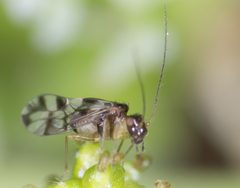
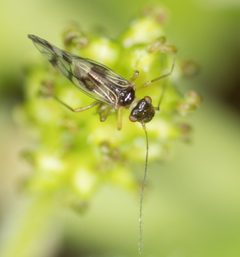
The free areola postica distinguishes winged from many other psocopteran . require examination of other morphological characters for family-level identification. The combination of infraorder Homilopsocidea placement and presence of free areola postica (when wings present) supports family assignment.
Images
Appearance
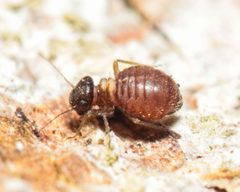
Small, soft-bodied insects typical of barklice. Winged forms possess a free areola postica—a detached in the forewing venation between the and media. Many are , lacking wings entirely. Body form varies from typical barklice to highly modified in some specialized species.
Habitat
Diverse; includes arboreal vegetation such as bushes and trees, with some showing strong substrate specificity. Documented associations include Genista scorpius, Rosmarinus officinalis, and Cistus laurifolius. Some species may inhabit confined spaces such as tunnels in wood or possibly or nests.
Distribution
Widespread but patchily recorded: Europe (including Scandinavia: Denmark, Norway, Sweden), North America (Canada, USA), East Africa (Zanzibar), and Australia. Central Spain has been specifically studied for selection patterns.
Seasonality
At least some overwinter as , with spring activity (e.g., April) coinciding with specific foliage conditions of plants.
Host Associations
- Genista scorpius - Primary plant; provides substrate through dried foliageStrongly preferred over other plants in central Spain
- Rosmarinus officinalis - Secondary plantLower densities than on Genista scorpius
- Cistus laurifolius - Secondary plantLower densities than on Genista scorpius
Life Cycle
Overwinters as in at least some ; appears synchronized with seasonal changes in plant foliage.
Behavior
through color matching (homochromous grey coloration with dried vegetation) has been documented. Some exhibit specialized hiding , such as revolving around shoots to avoid . One species shows possible phragmotic behavior—using a modified clunial plate to close tunnel entrances.
Similar Taxa
- Other Homilopsocidea familiesShare infraorder placement but differ in wing venation details; specifically distinguished by free areola postica
- Psilopsocus mimulusConvergent morphological modifications for tunnel-dwelling; both show adaptations suggesting phragmotic , though in different
More Details
Wing dimorphism
The shows extensive wing reduction, with many completely . This has led to specialized morphological evolution in some lineages, including the Yuntapsocinae described from South Australia.
Taxonomic history
established by Pearman in 1936. The number of recognized has varied between sources (26–32+), reflecting ongoing taxonomic refinement.
Sources and further reading
- BugGuide
- Wikipedia
- GBIF taxonomy match
- iNaturalist taxon
- NCBI Taxonomy
- Catalogue of Life
- An apterous, possibly phragmotic new species representing a new genus and subfamily of Elipsocidae (Psocoptera) from South Australia
- Phenology and Crypsis as Possible Determinants of Habitat Selection in Populations of Hemineura bigoti from Central Spain (Psocoptera: Elipsocidae)