
Menacanthus stramineus
(Nitzsch, 1818)
Chicken Body Louse, Poultry Body Louse
Menacanthus stramineus, commonly known as the chicken , is an obligate of domestic chickens (Gallus gallus domesticus). It is the most abundant and widely distributed on poultry worldwide. All life stages occur on the , where they feed primarily on feathers and skin debris, occasionally consuming blood from pin feathers. Heavy cause feather loss, skin irritation, reduced production, and decreased feed conversion . The species shows temperature-seeking , aggregating in warmer body regions such as the vent, breast, back, and under the wings.
Pronunciation
How to pronounce Menacanthus stramineus: /ˌmɛnəˈkænθəs strəˈmɪniəs/
These audio files are automatically generated. While they are not always 100% accurate, they are a good starting point.
Identification
Distinguished from other by its straw-colored body and preference for feather feeding rather than blood feeding. The fluff (Goniocotes gallinae) is smaller and more slender, restricted to down feathers. Menopon gallinae (shaft louse) has a more elongated body and feeds primarily on feather shafts. Menacanthus stramineus is larger, more robust, and occupies broader body regions including breast, back, and vent areas. Microscopic examination of and structure confirms identification.
Images
Appearance
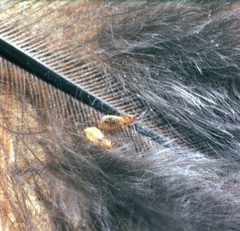
are dorsoventrally flattened, wingless insects approximately 3–4 mm in length. Body color ranges from pale yellow to straw-colored (hence the specific epithet 'stramineus,' meaning straw-colored). The is broad and rounded with short . Mouthparts are of the chewing type, adapted for consuming feathers and epidermal debris. Legs are robust with strong claws adapted for gripping feather shafts. Nymphs resemble smaller versions of adults and undergo three instars before reaching maturity.
Habitat
Strictly parasitic on domestic chickens; all life stages complete their development on the bird. Within the host environment, shows microhabitat selection based on temperature gradients, preferring warmer body regions. Survives only briefly off-host; are cemented to feather bases and nymphs require host contact for development.
Distribution
distribution associated with domestic chicken husbandry. Documented across Europe, Africa, Asia-Temperate, Asia-Tropical, and Australasia regions. Present wherever domestic chickens are raised, including both commercial production systems and backyard flocks.
Seasonality
Year-round presence on ; abundance fluctuates with host , environmental temperature, and management practices. Populations increase during warmer months and in conditions of poor control.
Diet
Chewing that feeds primarily on feathers, feather debris, and epidermal . Occasionally consumes blood from pin feathers and damaged skin. Does not require blood meals for survival, distinguishing it from sucking lice.
Host Associations
- Gallus gallus domesticus - obligate Domestic chicken; primary and only known . All life stages complete development on host.
Life Cycle
Hemimetabolous development with three nymphal instars. (nits) are cemented to feather bases, particularly in vent and breast regions. varies with temperature. Nymphs emerge and immediately begin feeding on . Development from egg to takes approximately 2–3 weeks under optimal conditions. Adults live 2–3 weeks. Entire occurs on host; off-host survival limited to hours.
Behavior
Temperature-seeking results in in warmer body regions (vent, breast, back, under wings). Avoids cooler extremities. Increases preening behavior in , which may serve as a behavioral indicator of . Dustbathing by hosts reduces through mechanical removal and desiccation. Low-level infestations trigger increased host preening even before visible damage occurs.
Ecological Role
of domesticated with no known wild . influenced by (dustbathing, preening) and environmental conditions. Serves as indicator of poultry management quality.
Human Relevance
Significant economic pest of poultry production. Causes reduced production, decreased feed , feather loss, and skin damage. Heavy cause welfare concerns. Control relies on including environmental management, dustbathing substrates (, kaolin clay, sulfur), and topical . Not zoonotic; does not infest humans.
Similar Taxa
- Goniocotes gallinaeFluff ; smaller, more slender, restricted to down feathers rather than broad body regions
- Menopon gallinaeShaft ; more elongated body, feeds primarily on feather shafts rather than feather vane and skin debris
- Cuclotogaster heterographusHead louse; restricted to and neck region, distinguished by preference
More Details
Temperature-dependent distribution
Research demonstrates that distribution across the chicken body correlates with surface temperature preferences, with higher densities in warmer regions and lower densities in cooler areas. This microhabitat selection is an active behavioral response rather than passive .
Welfare impact at low infestation levels
Recent studies show that even low-level affect chicken welfare, triggering increased preening and causing skin in moderately infested birds. This suggests economic damage thresholds may be lower than previously recognized.
Dustbathing as control mechanism
Dustbathing in chickens serves an adaptive anti- function. Studies show that dustbathing in materials such as , kaolin clay, or sulfur can reduce by 80–100% within one week of use. Sulfur shows residual effects extending control even after dustbox removal.
Sources and further reading
- BugGuide
- GBIF taxonomy match
- iNaturalist taxon
- NCBI Taxonomy
- Catalogue of Life
- Encyrtid Holdings | Entomology Research Museum
- Backyard Chickens Harbor Greater Diversity of Mites and Lice than Farm-raised Chickens
- Backyard Chickens May Have Mites, Lice and Fleas
- Menacanthus stramineus Archives - Entomology Today
- Biology of the chicken body louse, Menacanthus stramineus
- Distribution of Menacanthus stramineus in Relation to Chickens' Surface Temperatures
- The Effect of Host Beak Condition on the Size of Menacanthus Stramineus Populations of Domestic Chickens
- Case Report of Mixed Infestation of Menacanthus stramineus and Menopon gallinae in Commercial Pullets in Ibadan, Nigeria
- Beak condition and cage density determine abundance and spatial distribution of northern fowl mites, Ornithonyssus sylviarum, and chicken body lice, Menacanthus stramineus, on caged laying hens
- Housing and dustbathing effects on northern fowl mites ( Ornithonyssus sylviarum ) and chicken body lice ( Menacanthus stramineus ) on hens
- Low levels of chicken body louse (Menacanthus stramineus) infestations affect chicken welfare in a cage-free housing system
- Responses of Ornithonyssus sylviarum (Acari: Macronyssidae) and Menacanthus stramineus (Phthiraptera: Menoponidae) to Gradients of Temperature, Light, and Humidity, With Comments on Microhabitat Selection on Chickens