
Pediculus humanus capitis
de Geer, 1778
Human Head Louse, Head Louse
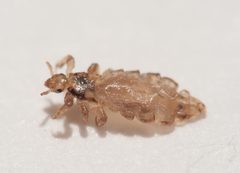
The human is an obligate specialized for life on human scalp hair. Unlike its close relative the body louse, it has remained associated with hair rather than clothing throughout human evolution. in many regions have developed widespread resistance to pyrethrin and permethrin , complicating control efforts. Transmission occurs primarily through direct -to-head contact, with clustering in settings where children interact closely.
Pronunciation
How to pronounce Pediculus humanus capitis: //pɛˈdɪkjʊləs ˈhjuːmənəs ˈkæpɪtɪs//
These audio files are automatically generated. While they are not always 100% accurate, they are a good starting point.
Identification
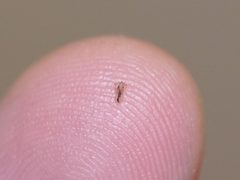
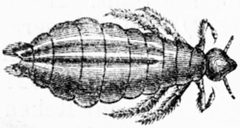
Confirmed by presence of nits () firmly cemented to hair shafts near the scalp, or observation of live mobile . Nits appear as tiny white or yellowish ovals attached to one side of hair, unlike dandruff which moves freely. Distinguished from crab lice (Pthirus pubis) by and body shape— are longer and narrower, adapted for scalp hair rather than coarser pubic hair.
Images
Habitat
Exclusively associated with human scalp hair. Requires warm, humid conditions near the skin surface. Cannot survive more than 24–48 hours away from a human .
Distribution
, occurring wherever humans are present. Documented on all inhabited continents including remote in Galápagos Islands and Antarctica research stations.
Seasonality
Year-round activity; no true seasonal dormancy. rates often peak in late summer and early autumn when children return to school and close contact increases.
Diet
Strict : feeds exclusively on human blood, with multiple daily meals required for survival and .
Host Associations
- Homo sapiens - obligate only known
Life Cycle
with three stages: (nit), nymph, and . Female attaches nits to hair shafts with proteinaceous glue; eggs hatch in 7–10 days. Nymphs pass through three instars over 7–10 days before reaching adulthood. Total time approximately 3 weeks under favorable conditions. Adults live 3–4 weeks.
Behavior
Highly -specific and sedentary; moves between hosts almost exclusively during direct -to-head contact. Rarely transfers via shared combs, hats, or bedding despite common belief. Females deposit 6–10 daily. and scratching by hosts represent primary defensive responses.
Ecological Role
None outside of human association; no free-living or environmental ecological function.
Human Relevance
Significant nuisance pest causing pruritus, secondary skin from scratching, and social stigma. Not a known , unlike the body louse . Management complicated by widespread resistance; mechanical removal via wet combing remains effective alternative. School-based screening programs historically common in many countries.
Similar Taxa
- Pediculus humanus humanusBody louse ; distinguished by microhabitat (clothing seams vs. scalp hair), slightly larger size, and epidemiological role as of , , and .
- Pthirus pubisCrab or pubic louse; distinguished by broader, crab-like body shape, shorter legs relative to body, and restriction to coarser pubic and body hair.
Misconceptions
Common belief that jump or fly between —they are wingless and crawl only. Misconception that sharing hats, combs, or bedding is a major transmission route; actual transmission requires sustained -to-head contact. Assumption that lice prefer dirty hair; is unrelated to hygiene.
Sources and further reading
- BugGuide
- GBIF taxonomy match
- iNaturalist taxon
- NCBI Taxonomy
- Catalogue of Life
- There's a Bed Bug in My Christmas Stocking! | Bug Squad
- The Role of School Nurses in Integrated Pest Management for Public Health
- Archive — Bug of the Week
- Lousy times: Human head louse, Pediculus humanus capitis, and human body louse, Pediculus humanus humanus — Bug of the Week
- A Better Picture of Head-Lice Transmission, Aided by Math and a Fine-Toothed Comb
- Two New Species of Chewing Lice Discovered on Stealthy Songbird