
Pthirus pubis
(Linnaeus, 1758)
Crab Louse, Pubic Louse, Crabs
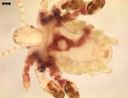
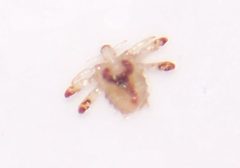
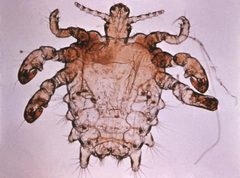
is an obligate of humans, the sole in its to infest humans. It is dorsoventrally flattened, wingless, and 1-2 mm in length, with a crab-like appearance due to its broad, short body and specialized clawed legs adapted for grasping coarse human hair. The species has infested humans for approximately 10,000 years, with archaeological evidence from Roman and Medieval Britain, pre-Columbian South America, and southern Peru. Unlike the closely related and (Pediculus humanus), P. pubis is extremely sedentary, rarely leaving direct contact with the body, and is transmitted primarily through sexual contact.
Pronunciation
How to pronounce Pthirus pubis: /ˈθaɪrəs ˈpjuːbɪs/
These audio files are automatically generated. While they are not always 100% accurate, they are a good starting point.
Identification
Distinguished from (Pediculus humanus capitis) and (P. h. humanus) by its broader, shorter, crab-like body shape and specialized claw adapted for grasping coarse pubic hair rather than cylindrical scalp hair. are 1-2 mm long, light cream-colored, with three pairs of legs bearing prominent claws, two , and a dorsoventrally flattened body. The can be distinguished from its Pthirus gorillae (which infects gorillas) only by association and subtle morphometric differences.
Images
Habitat
Human pubic hair; occasionally eyelashes, eyebrows, and other coarse body hair regions. Extremely sedentary, maintaining close contact with the body and rarely leaving the hair shaft.
Distribution
. Worldwide approximately 2% in general , with documented rates of 1.3-4.6% in Spanish STD clinics (1988-2001), 1.7% men and 1.1% women in Australian STD clinics (1988-1991), and declining from 3.5% male/2% female in UK (1991) to 1% (2004). Higher rates (7-9%) reported in Nepal co-occurring with other .
Diet
Exclusively human blood; obligate feeder.
Host Associations
- Homo sapiens - obligate Humans are the only known ; no other animal documented
Life Cycle
(nits) deposited on hair shafts; viable eggs required for of active . Empty are not diagnostic. The complete occurs on the human .
Behavior
Extremely sedentary lifestyle; adapted to remain on the body and rarely leave. Transmission occurs through close intimate or skin-to-skin contact, primarily during sexual contact. Transmission via objects, clothing, or toilet seats is highly unlikely due to the ' sedentary nature and inability to survive away from the host.
Human Relevance
Classified as a sexually transmitted . Causes pubis, with including itching and visible or nits. Serves as an epidemiological indicator for co-occurring STD in surveillance contexts. Treatment involves pyrethrin-based crèmes, though resistance is increasing; mechanical removal is also effective if thorough. Misconceptions about transmission routes and treatment (e.g., belief that are effective) are common among the general public.
Similar Taxa
- Pediculus humanus capitis differ in microhabitat preference (scalp hair), body shape (elongated rather than crab-like), and claw structure adapted for cylindrical rather than coarse hair.
- Pediculus humanus humanus differ in preference (clothing seams), more elongated body form, and association with different epidemiological patterns.
- Pthirus gorillaeGorilla is morphologically similar but restricted to gorilla ; distinguished by host association and subtle morphometric differences.
Misconceptions
Common misconceptions include: belief that transmission occurs via toilet seats or shared clothing (highly unlikely due to sedentary ); belief that are an effective treatment (they are not; pyrethrin-based or mechanical removal are required); and confusion with or regarding appropriate treatment and .
Sources and further reading
- BugGuide
- GBIF taxonomy match
- iNaturalist taxon
- NCBI Taxonomy
- Catalogue of Life
- There's a Bed Bug in My Christmas Stocking! | Bug Squad
- Two New Species of Chewing Lice Discovered on Stealthy Songbird
- Investigation of Morphological Characteristics of Pubic lice (Pthirus pubis, Linnaeus, 1758) Kasık bitlerinin Morfolojik Özelliklerinin İncelenmesi (Pthirus pubis, Linnaeus, 1758)
- Maintenance of the crab louse, <italic>Pthirus pubis</italic>, in the laboratory and behavioural studies using volunteers
- Pubic Lice (Pthirus pubis): History, Biology and Treatment vs. Knowledge and Beliefs of US College Students
- Maintenance of the crab louse,Pthirus pubis, in the laboratory and behavioural studies using volunteers
- Isolation, Amplification, and Sequencing of Human Mitochondrial DNA Obtained from Human Crab Louse, Pthirus Pubis (L.), Blood Meals
- Correction to "Pthirus pubis infestation of the scalp in a 4-month-old infant:A case report".