
Perlinella
Banks, 1900
Species Guides
2- Perlinella drymo(Striped Stone)
- Perlinella ephyre(Vernal Stone)
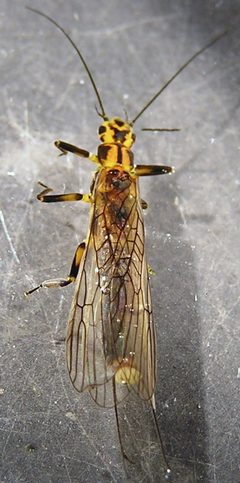
Perlinella is a of common stoneflies in the Perlidae, established by Nathan Banks in 1900. The genus contains at least three described : P. drymo (striped stone), P. ephyre (vernal stone), and P. zwicki. Members are found in eastern North America, particularly in the northeastern United States and extending south to Florida and Alabama. As perlid stoneflies, they are aquatic insects with nymphal stages in streams and rivers.
Pronunciation
How to pronounce Perlinella: //ˌpɛr.lɪˈnɛl.lə//
These audio files are automatically generated. While they are not always 100% accurate, they are a good starting point.
Identification
within Perlinella can be distinguished by specific morphological features, though detailed diagnostic characters require examination of genitalia. P. drymo and P. ephyre, both described by Newman in 1839, have long-standing taxonomic histories and can be separated by subtle differences in abdominal patterning and wing venation. P. zwicki, described in 1988, differs in specific genitalic structures. Accurate identification to species level typically requires microscopic examination and reference to original species descriptions.
Images
Habitat
Streams and rivers with clean, well-oxygenated water. Nymphs inhabit the benthic zone of lotic freshwater systems.
Distribution
Eastern North America: northeastern United States, Alabama, Arkansas, Florida, and Georgia.
Life Cycle
Hemimetabolous development with , nymph, and stages. Nymphs are aquatic and undergo multiple instars before emerging as winged adults.
Ecological Role
Nymphs function as or in stream , contributing to nutrient cycling and serving as indicators of good water quality. Their presence indicates well-oxygenated, minimally polluted aquatic .
Human Relevance
Similar Taxa
- AcroneuriaAlso in Acroneuriinae; differs in specific genitalic structures and body proportions
- ParagnetinaRelated perlid in same ; separable by wing venation patterns and abdominal markings
More Details
Species epithets
The specific epithet 'drymo' derives from Greek drymos (thicket/coppice), while 'ephyre' refers to a spring or fountain, reflecting the vernal pattern of P. ephyre. 'Zwicki' honors the German entomologist Peter Zwick.