
Hesperoperla hoguei
Baumann & Stark, 1980
Banded Stone
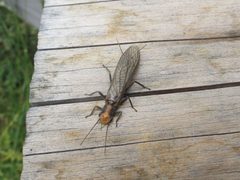
Hesperoperla hoguei is a of in the Perlidae, commonly known as the banded stone. It is a member of the Acroneuriinae, a group of predatory stoneflies often associated with flowing freshwater . The species was described by Baumann and Stark in 1980 and is known from western North America, particularly California. As with other perlid stoneflies, it likely inhabits cool, well-oxygenated streams.
Pronunciation
How to pronounce Hesperoperla hoguei: /ˌhɛspəroʊˈpɜrlaɪ ˈhoʊɡwi/
These audio files are automatically generated. While they are not always 100% accurate, they are a good starting point.
Identification
As an Acroneuriinae , Hesperoperla hoguei likely exhibits the robust body form and reduced gill structures characteristic of this . in the Hesperoperla are distinguished from related genera by genitalic characters, particularly male aedeagal . The specific epithet 'hoguei' and 'banded stone' suggest possible banded patterning on the body or wings, though this has not been explicitly documented in the available sources. Definitive identification requires examination of genitalia.
Images
Habitat
Based on -level characteristics and distribution records, Hesperoperla hoguei is associated with lotic freshwater —specifically cool, flowing streams with high oxygen content. The single iNaturalist observation and GBIF records indicate occurrence in California, suggesting a Mediterranean or montane stream habitat context.
Distribution
Documented from California and more broadly from the Nearctic region of North America. GBIF distribution records specifically list California as a present location.
Life Cycle
As a (Plecoptera), Hesperoperla hoguei undergoes with , nymph, and stages. Nymphs are aquatic and likely predatory, as is characteristic of the Perlidae. Specific details of voltinism or developmental timing are not documented.
Ecological Role
As a perlid , nymphs likely function as or omnivores in stream , contributing to nutrient cycling and serving as prey for fish and other aquatic predators. are terrestrial and do not feed.
Similar Taxa
- Other Hesperoperla speciesCongeneric share similar body plans and require genitalic examination for definitive separation.
- Other Acroneuriinae genera (e.g., Acroneuria, Attaneuria)These share the robust perlid and reduced gill structures; accurate identification relies on male aedeagal and female subgenital plate characters.
More Details
Taxonomic history
Described by Baumann and Stark in 1980, placing it among the more recently described perlid .
Data scarcity
With only one iNaturalist observation and limited published records, much of the of this remains undocumented. The low observation count may reflect genuine rarity, restricted distribution, or under-sampling of its .