
Hesperoperla
Banks, 1938
common stoneflies
Species Guides
2- Hesperoperla hoguei(Banded Stone)
- Hesperoperla pacifica(golden stonefly)
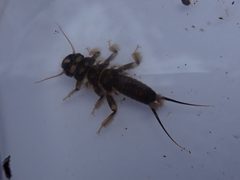
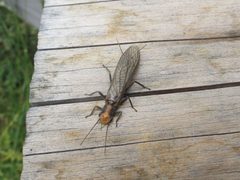
Hesperoperla is a of perlid stoneflies comprising at least two described : Hesperoperla hoguei (banded stone) and Hesperoperla pacifica (golden stonefly). Species in this genus are found in western North American streams, with documented in California, Colorado, and other western states and provinces. The genus has been studied for its response to stream flow regimes, with voltinism patterns varying between stable and variable hydrological conditions.
Pronunciation
How to pronounce Hesperoperla: //hɛsˌpɛroʊˈpɛr.lə//
These audio files are automatically generated. While they are not always 100% accurate, they are a good starting point.
Images
Habitat
Streams, including both stable groundwater-fed streams and hydrologically variable snowmelt-fed streams.
Distribution
Western North America: recorded from California, Colorado, Arizona, Alaska, Alberta, and British Columbia.
Life Cycle
Voltinism is plastic and influenced by flow regime. In stable groundwater-fed streams, Hesperoperla pacifica exhibits a (one-year) with higher growth rates. In hydrologically variable snowmelt-fed streams, it exhibits a semivoltine (two-year) life cycle. Nymphal development is tracked through the year with timing differing between flow regimes; emergence occurs later in variable streams.
Behavior
Timing of varies with stream flow regime, with delayed emergence in hydrologically variable environments compared to stable streams.
Ecological Role
Contributes to secondary production in stream . Production has been quantified in comparative studies of different stream types.
Sources and further reading
- BugGuide
- Wikipedia
- GBIF taxonomy match
- iNaturalist taxon
- NCBI Taxonomy
- Catalogue of Life
- The life cycles of Claassenia sabulosa AND Hesperoperla pacifica (Plecoptera: Perlidae) in two Colorado streams
- Influence of Flow Regime on Life History, Production, and Genetic Structure of Baetis tricaudatus (Ephemeroptera) and Hesperoperla pacifica (Plecoptera)