
Timema podura
Strohecker, 1936
Sierra Nevada timema, Sierra Nevada Mountains Timema
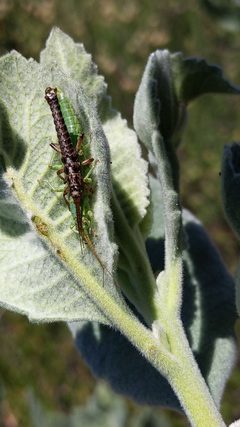
Timema podura is a of walkingstick insect in the Timematidae. It is to the Sierra Nevada region of North America. Like other Timema species, it is known for cryptic camouflage that matches its vegetation. The species was described by Strohecker in 1936.
Pronunciation
How to pronounce Timema podura: /tɪˈmiːmə poʊˈdʊrə/
These audio files are automatically generated. While they are not always 100% accurate, they are a good starting point.
Images
Distribution
California, United States; Baja California, Mexico. Records are concentrated in the Sierra Nevada mountain range.
Host Associations
- Ceanothus - plantReported for Timema ; specific host records for T. podura are not clearly documented in available sources
Similar Taxa
- Timema cristinaeBoth are Timema with cryptic green and brown color morphs adapted to shrub ; T. cristinae has been extensively studied for speciation dynamics involving Ceanothus host plants, while T. podura occurs in a different geographic range (Sierra Nevada vs. Santa Ynez Mountains and other California coastal ranges)
More Details
Taxonomic note
Timema podura is one of approximately 20-25 described in the Timema, which represents a basal lineage of . The genus is notable for having secondarily lost wings in both sexes, unlike most other stick insects.
Research context
While extensive research on Timema speciation and has focused on T. cristinae and T. poppensis, T. podura has received less study. The as a whole serves as a model system for understanding ecological speciation and the role of in impeding divergence.