
Capnobotes
Scudder, 1897
shield-backed katydids, longwings
Species Guides
8- Capnobotes arizonensis(Arizona longwing)
- Capnobotes attenuatus(slender longwing)
- Capnobotes bruneri(Bruner Longwing)
- Capnobotes fuliginosus(sooty longwing)
- Capnobotes granti(Grant's Longwing)
- Capnobotes occidentalis(Western Longwing)
- Capnobotes spatulatus(Spatulate Longwing)
- Capnobotes unodontus(one-tooth longwing)
Capnobotes is a North American of shield-backed katydids ( Tettigoniidae) containing approximately nine described . Members are commonly known as "longwings" due to their elongated forewings. The genus was established by Scudder in 1897 and is primarily distributed across arid and semi-arid regions of the southwestern United States and northern Mexico. Species exhibit morphological diversity in body form and wing structure, with reflecting these traits (slender, sooty, spatulate, etc.).
Pronunciation
How to pronounce Capnobotes: //ˌkæpnoʊˈboʊtiːz//
These audio files are automatically generated. While they are not always 100% accurate, they are a good starting point.
Identification
Distinguished from other Tettigoniidae by the combination of shield-backed pronotum and exceptionally long, narrow forewings. Within the genus, identification relies on specific morphological traits: C. arizonensis and C. occidentalis by geographic range and subtle genitalic differences; C. attenuatus by extreme body slenderness; C. fuliginosus by dark, sooty coloration; C. spatulatus by distinctive spatulate wing tips; C. unodontus by single-toothed male genital structures. Examination of male and genitalia typically required for definitive species identification.
Images
Appearance
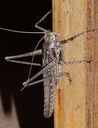
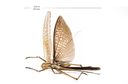
Medium-sized katydids with elongated, narrow forewings that extend well beyond the , giving the "longwing" . Body typically dorsoventrally flattened with a shield-like pronotum covering much of the . Coloration ranges from pale to dark brown or gray, often with mottled or speckled patterns providing camouflage. Some exhibit distinctive modifications: C. spatulatus has spatulate (spoon-shaped) forewings, C. attenuatus has an unusually slender body form, and C. fuliginosus is notably dark (sooty) in coloration.
Habitat
Arid and semi-arid environments including desert scrub, chaparral, grasslands, and open woodlands. Found from low elevations to moderate mountain slopes. Vegetation associations include creosote bush scrub, sagebrush steppe, pinyon-juniper woodland, and desert grasslands. Occupies relatively dry microhabitats compared to many other .
Distribution
Southwestern United States (Arizona, California, Colorado, Nevada, New Mexico, Texas, Utah) and northern Mexico (Baja California, Chihuahua, Sonora, and adjacent states). Distribution varies by : C. arizonensis primarily Arizona and adjacent areas; C. occidentalis more western range; C. fuliginosus widespread across much of range.
Seasonality
active primarily during summer months, with peak activity typically June through September depending on elevation and latitude. Seasonal timing varies by and local climate conditions. Nymphs present in spring and early summer.
Behavior
Primarily . Males produce -specific calling songs by stridulation (rubbing forewings together) to attract females. Calling typically occurs at night from elevated perches on vegetation. capability varies; some species are relatively sedentary while others are capable of sustained flight. Cryptic during daylight hours, remaining motionless against substrate to avoid detection.
Ecological Role
Herbivorous consumers in arid . Serve as prey for various vertebrate and including birds, lizards, spiders, and predatory insects. Contribution to nutrient cycling through herbivory and as detritus upon death.
Human Relevance
No significant direct economic importance. Subject of scientific study in orthopteran and desert . Occasionally encountered by naturalists and entomologists in southwestern fieldwork. Some may be incidentally observed by hikers and outdoor recreationists in their native ranges.
Similar Taxa
- Tettigoniidae (other genera)Other lack the distinctive combination of shield-backed pronotum with extremely elongated, narrow forewings characteristic of Capnobotes
- Stenopelmatus (Jerusalem crickets)Superficially similar flattened body form but belong to different (Stenopelmatidae), are wingless, and have much larger relative to body
- EremopedesAnother North American shield-backed katydid ; distinguished by wing structure and male genitalia
More Details
Etymology
name derived from Greek 'kapnos' (smoke) and 'botes' (grazer/walker), possibly alluding to the dark, sooty coloration of the type C. fuliginosus or to the smoky, arid occupied by the genus
Taxonomic history
Originally described by Scudder in 1897 with C. bruneri as type ; subsequent revisions by Rehn (1901, 1904) and Rentz & Birchim (1968) expanded the to current circumscription