
Capnobotes fuliginosus
(Thomas, 1872)
sooty longwing
Capnobotes fuliginosus, commonly known as the sooty longwing, is a large found in arid regions of western North America and Mexico. First described by Cyrus Thomas in 1872, this species reaches up to 75 mm in length and is characterized by its brownish-gray coloration, long wings, and notably darker hindwings that are displayed when the insect is startled. It produces a loud, continuous, shrill song and is known to be preyed upon by the Palmodes praestans.
Pronunciation
How to pronounce Capnobotes fuliginosus: /ˌkæpnəˈboʊtiːz ˌfjʊlɪdʒɪˈnoʊsəs/
These audio files are automatically generated. While they are not always 100% accurate, they are a good starting point.
Identification
The combination of large size (up to 75 mm), brownish-gray coloration, long wings with distinctly darker hindwings, and shield-like pronotum distinguishes this . The behavioral display of exposing dark hindwings when disturbed is a notable field characteristic. The loud, continuous, shrill song is also diagnostic. Similar katydids in the same region generally lack the pronounced contrast between forewing and hindwing coloration.
Images
Appearance
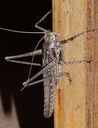
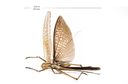
reach up to 75 mm (3.0 in) in length to the wingtips. Body coloration is brownish-gray. The forewings are long, extending well beyond the . Hindwings are distinctly darker than the forewings. The has a shield-like pronotum (shield back). When startled, individuals expose their dark hindwings.
Habitat
Arid and semi-arid environments including deserts of California and the Great Basin region. Found in association with vegetation in dry, open landscapes. Highly active on hot nights.
Distribution
Western United States and northern Mexico. Specific records from central Nevada, Utah, southern California, New Mexico, Texas, Colorado, and Arizona. Mexican distribution includes northeastern Mexico.
Seasonality
active during summer months. Highly active on hot nights.
Diet
. Documented to feed on nymphs and of the Bootettix argentatus on foliage during summer. General plant material consumption also inferred from omnivorous designation.
Host Associations
- Bootettix argentatus - preynymphs and consumed on foliage during summer
Behavior
Produces a loud, continuous, shrill song. When startled, individuals expose their dark hindwings in a defensive display. Highly active on hot nights, suggesting or activity patterns.
Ecological Role
Serves as prey for the spider wasp Palmodes praestans, which has been documented to attack and drag even large individuals into its burrow. Also documented as for . As an omnivore including on other orthopterans, may function as both and prey in desert .
Similar Taxa
- other Capnobotes speciescongeneric may share general body plan and preferences, but C. fuliginosus distinguished by specific wing coloration pattern and documented distribution
- other desert Tettigoniidaeshare arid preferences, but C. fuliginosus distinguished by combination of large size, long wings with dark hindwings, and shield-like pronotum
More Details
Original description
First formally described in 1872 by Cyrus Thomas as Locusta fuliginosus. Later transferred to Capnobotes.
Predator-prey dynamics
The Palmodes praestans, despite being smaller than C. fuliginosus, successfully preys on this . A 1919 publication noted this relationship despite the katydid's 'large size' and 'formidable nature'. A 2005 study documented a wasp dragging a katydid instar into its burrow.
Historical collection
First recorded at Dinosaur National Monument in 1952, where three were discovered according to Entomological News.