
Bootettix argentatus
Bruner, 1889
Creosote Bush Grasshopper
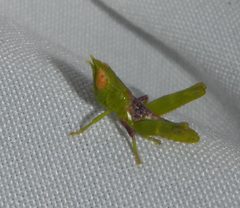
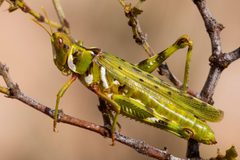
Bootettix argentatus is a slant-faced grasshopper in the Acrididae, commonly known as the creosote bush . The exhibits extreme dietary specialization, feeding exclusively on the creosote bush Larrea divaricata. It is distributed across arid regions of the southwestern United States, Mexico, and Central America.
Pronunciation
How to pronounce Bootettix argentatus: /buːˈtɛtɪks ˌɑːrdʒənˈteɪtəs/
These audio files are automatically generated. While they are not always 100% accurate, they are a good starting point.
Identification
Distinguished by its monophagous association with creosote bush (Larrea divaricata); presence on this plant is a strong indicator of identity. As a member of the slant-faced grasshopper Gomphocerinae, it possesses the characteristic slanted facial profile. Specific morphological diagnostic features require further documentation.
Images
Habitat
Arid and semi-arid regions dominated by creosote bush (Larrea divaricata), including desert scrub and shrublands.
Distribution
Southwestern United States (Arizona, California, southeast Washington), Mexico, and Central America.
Diet
Strictly monophagous; feeds exclusively on creosote bush (Larrea divaricata).
Host Associations
- Larrea divaricata - obligate food plantsole ; monophagous diet
Ecological Role
Herbivore tightly linked to creosote bush ; its extreme specificity makes it a potential for creosote bush health.
Similar Taxa
- Other Acrididae speciesMost grasshoppers in the region are or have broader ranges; B. argentatus is distinguished by its exclusive association with Larrea divaricata.
More Details
Extreme dietary specialization
The monophagy of Bootettix argentatus on Larrea divaricata is notable; creosote bush produces toxic resins that deter most herbivores, suggesting this possesses biochemical adaptations to process these compounds.