
Eremopedes
Scudder, 1897
Species Guides
6- Eremopedes balli(Ball's Shieldback)
- Eremopedes bilineatus(Two-lined Shieldback)
- Eremopedes covilleae(Creosote Shieldback)
- Eremopedes ephippiatus(Saddled Shieldback)
- Eremopedes kelsoensis(Kelso Shieldback)
- Eremopedes scudderi(Scudder's Shieldback)
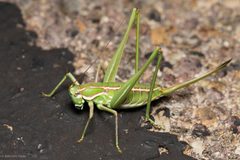
Eremopedes is a of shield-backed katydids ( Tettigoniidae) established by Scudder in 1897. The genus comprises approximately 16-17 described distributed in arid regions of western North America. Members of this genus are characterized by their distinctive shield-like pronotum that extends backward over the , a trait common to the Tettigoniinae. These insects are primarily and associated with dry, open .
Pronunciation
How to pronounce Eremopedes: /ˌɛrəˈmɒpɛˌdiːz/
These audio files are automatically generated. While they are not always 100% accurate, they are a good starting point.
Identification
Members of Eremopedes can be distinguished from other Tettigoniidae by the enlarged, shield-shaped pronotum that covers most or all of the , giving the 'shield-backed' appearance. The pronotum is typically broader and more flattened than in related genera such as Atlanticus or Neduba. -level identification within Eremopedes requires examination of male genitalia and subtle differences in pronotal shape and coloration.
Images
Habitat
Arid and semi-arid environments including desert scrub, grasslands, and open woodland edges. Associated with low vegetation and ground cover in dry regions.
Distribution
Western North America: documented from Mexico, Arizona, California, Colorado, and Nevada. Distribution corresponds to arid and semi-arid zones of the southwestern United States and adjacent Mexico.
Behavior
activity pattern typical of Tettigoniidae. Males produce stridulatory songs for mate attraction, though specific song characteristics vary among .
Ecological Role
Herbivorous component of in arid ; serves as prey for various vertebrate and .
Similar Taxa
- AtlanticusAlso shield-backed katydids, but with generally narrower pronotum and different geographic distribution (primarily eastern North America).
- NedubaSimilar shield-backed , but pronotum shape and male genitalia structure differ; some overlap in range.
- SteiroxysAnother of shield-backed katydids, distinguished by differences in pronotal extension and body proportions.