
Eremopedes bilineatus
(Thomas, 1875)
Two-lined Shieldback
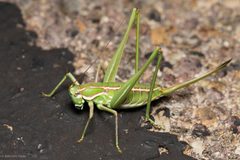
Eremopedes bilineatus, known as the two-lined shieldback, is a of shield-backed katydid in the Tettigoniidae. It is found in the southwestern United States, specifically Arizona, New Mexico, and Texas. The species was originally described as Steiroxys bilineata by Thomas in 1875. Like other members of the Eremopedes, it possesses the characteristic shield-like pronotum that extends over the , a trait that gives this group their .
Pronunciation
How to pronounce Eremopedes bilineatus: /ɛˌrɛmoʊˈpiːdiːz ˌbɪlɪˈneɪtəs/
These audio files are automatically generated. While they are not always 100% accurate, they are a good starting point.
Identification
The specific epithet 'bilineatus' (meaning 'two-lined') likely refers to distinctive longitudinal stripes on the body, though this requires verification. As a member of the shield-backed katydids, it can be distinguished from other groups by the greatly enlarged, shield-like pronotum that covers most or all of the . Within the Eremopedes, identification to level requires examination of specific morphological features such as body patterning and male genitalia structure.
Images
Distribution
Southwestern United States: Arizona, New Mexico, and Texas. Distribution records are based on documented occurrence data.
Similar Taxa
- Other Eremopedes speciesMultiple occur in the southwestern United States and share the characteristic shield-shaped pronotum; precise identification requires detailed examination of morphological features.
- Other shield-backed katydid genera (e.g., Atlanticus, Neduba)These share the enlarged pronotum covering the but differ in geographic distribution and specific structural features of the pronotum and genitalia.
More Details
Taxonomic History
Originally described by Cyrus Thomas in 1875 as Steiroxys bilineata, this was later transferred to the Eremopedes. The basionym Steiroxys bilineata is now treated as a synonym.
Nomenclatural Note
The specific epithet was originally published as 'bilineata' (feminine) to agree with Steiroxys (feminine), but became 'bilineatus' when transferred to the masculine Eremopedes.