
Atlanticus
Scudder, 1894
Eastern Shieldbacks
Species Guides
7- Atlanticus americanus(American shieldback)
- Atlanticus davisi(Davis's shieldback)
- Atlanticus gibbosus(robust shieldback)
- Atlanticus glaber
- Atlanticus monticola(Least Shieldback)
- Atlanticus pachymerus(southern protean shieldback)
- Atlanticus testaceus(protean shieldback)
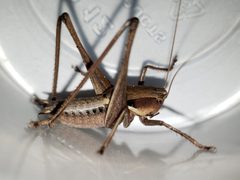
Atlanticus is a of katydids in the Tettigoniidae, commonly known as eastern shieldbacks. The genus comprises at least 50 described distributed discontinuously across North America and temperate eastern Asia. These insects belong to the tribe Drymadusini within the Tettigoniinae. Species in this genus are predatory, possessing enlarged adapted for capturing and consuming other insects.

Pronunciation
How to pronounce Atlanticus: //ætlænˈtaɪkəs//
These audio files are automatically generated. While they are not always 100% accurate, they are a good starting point.
Identification
Members of Atlanticus can be distinguished from other katydids by their shield-backed , relatively small rounded set high on the , and notably enlarged, heavily sclerotized with sharp dentes and incisors. The pronotum typically extends backward over the , giving a shield-like appearance. are long and multi-segmented. Live individuals are often green but fade to yellow or brown after death. Prominent coxal spines are present on the legs.
Images
Distribution
North America and temperate eastern Asia. Specific distribution records include Alabama in North America, and in Asia: South-central China, North-central China, Inner Mongolia, and Manchuria.
Diet
Predatory on other insects. Atlanticus testaceus has been observed catching and consuming caterpillars.
Similar Taxa
- NeobarrettiaBoth are predatory katydids with enlarged , but Neobarrettia such as N. spinosa (spiny bush katydid) possess distinct spines on the pronotum and exhibit conspicuous threat displays, features not characteristic of Atlanticus.
- OrchelimumMeadow katydids in this are rather than primarily predatory, lack the heavily sclerotized of Atlanticus, and typically have more slender body proportions.
Sources and further reading
- BugGuide
- Wikipedia
- GBIF taxonomy match
- iNaturalist taxon
- NCBI Taxonomy
- Catalogue of Life
- ID Challenge #2 | Beetles In The Bush
- Bug Eric: Wasp Wednesday: Great Golden Digger
- Reclassification of Pasteurella skyensis as Phocoenobacter skyensis comb. nov. and description of Phocoenobacter atlanticus sp. nov. isolated from diseased Atlantic salmon (Salmo salar) and lumpfish (Cyclopterus lumpus), with subdivision into Phocoenobacter atlanticus subspecies atlanticus subsp. nov. and Phocoenobacter atlanticus subspecies cyclopteri subsp. nov.
- A dual catalytic architecture promotes C-2 stereoinversion of CDP-glucose by the CDP-tyvelose 2-epimerase from Thermodesulfatator atlanticus.