
Scudderia pistillata
Brunner von Wattenwyl, 1878
Broad-winged Bush Katydid
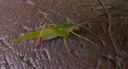
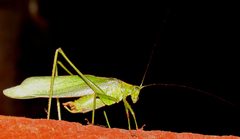
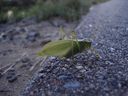
Scudderia pistillata is a of bush in the Tettigoniidae, commonly known as the broad-winged bush katydid. It is native to North America and is one of eight recognized species in the Scudderia found in the United States and southern Canada. Like other bush katydids, it is primarily and well-camouflaged in vegetation.
Pronunciation
How to pronounce Scudderia pistillata: /skʌˈdɛɹ.i.ə pɪˈstɪl.ə.tə/
These audio files are automatically generated. While they are not always 100% accurate, they are a good starting point.
Identification
male Scudderia pistillata can be distinguished from other Scudderia by the shape of the supra-anal plate ( process), a horn-like structure at the tip of the . In S. pistillata, this structure is not forked as in the widespread S. furcata, but has a different configuration specific to the species. Females possess a curved, knife-like ovipositor used to insert between leaf layers, creating kidney bean-shaped bulges at leaf edges. Living specimens in the field are extremely difficult to identify to species without examination of the male supra-anal plate, as folded wings typically conceal this diagnostic feature.
Images
Habitat
Vegetated areas including shrublands, woodlands, and forest edges where shrubs and broad-leaved plants provide food and -laying sites.
Distribution
Recorded from Illinois, Indiana, Iowa, Maine, and Massachusetts in the northeastern and midwestern United States. The full extent of its range within North America is not comprehensively documented.
Life Cycle
Females deposit in small batches between leaf layers using their ovipositor, with each female capable of laying up to 175 eggs total. Eggs overwinter and hatch the following spring. Nymphs progress through six instars, gradually developing wing pads and reproductive organs.
Behavior
Males produce a short, intermittent rasping song by rubbing file-and-scraper structures on their forewings: s-s-s-s-s-S-S-S-T. This discontinuous pattern likely reduces risk by making the caller harder to locate. Both sexes are capable fliers and are primarily .
Ecological Role
As a folivore, contributes to nutrient cycling through herbivory. Serves as prey for various including digger wasps such as Sphex ichneumoneus, which paralyzes katydids to provision nests for their larvae.
Similar Taxa
- Scudderia furcataFork-tailed bush is the most widespread and commonly encountered Scudderia across North America. Distinguished by the forked shape of the male supra-anal plate; S. pistillata lacks this forked configuration.
- Other Scudderia speciesSeven additional Scudderia occur in the United States and Canada. All require examination of male supra-anal plate for reliable identification; external appearance of living specimens is insufficient for species-level determination.
Sources and further reading
- BugGuide
- Wikipedia
- GBIF taxonomy match
- iNaturalist taxon
- NCBI Taxonomy
- Catalogue of Life
- Bodil Cass and 'The Curious Case of Katydids in California Citrus' | Bug Squad
- Bug Eric: Fork-tailed Bush Katydid
- Mandarin Boom Means Citrus Pest Management Must Evolve
- 🪲 Entomologizing w/ the WGNSS Entomology Group at Hughes Mountain Natural Area — 11 Oct 2025 | Beetles In The Bush
- Bug Eric: Wasp Wednesday: Great Golden Digger
- Bug Eric: November 2024