
Orchelimum pulchellum
Davis, 1909
Handsome meadow katydid
Orchelimum pulchellum, the handsome meadow katydid, is a medium-sized in the Tettigoniidae. It is distinguished from closely related by specific morphological features of the pronotum, , and hind . The species is found in moist forests and wetlands across the eastern United States, where it feeds on pollen, foliage, and opportunistically on other insects. It is active from mid-summer through mid-autumn in the northern parts of its range.
Pronunciation
How to pronounce Orchelimum pulchellum: /ɔːrˈkɛlɪməm pʊlˈkɛləm/
These audio files are automatically generated. While they are not always 100% accurate, they are a good starting point.
Identification
Distinguished from western relative Orchelimum nigripes by arcuate (not sinuate or sub-sinuate) caudal portion of lateral pronotum inferior to humeral sinus, brown tibiae (typically black in O. nigripes), and medial tooth on male at less acute angle. Distinguished from O. carinatum by absence of spines on inner carinae of hind . Distinguished from O. bullatum by narrower fastigium and presence of spines on outer carinae of hind femora. Distinguished from O. erythrocephalum by shared blue but differing in other markings and geographic range.
Images
Appearance
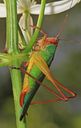
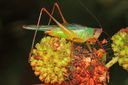
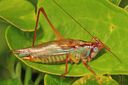
Body length 18–23 mm. Body green with reddish marks around the . white or yellow with blue . At rest, folded wings display a turquoise stripe. Tibiae brown. Male bear a medial tooth positioned at a less acute angle to the sinuate sinus. Female ovipositor long and sickle-shaped. Typically lacks spines on inner carinae of hind . Fastigium narrower than in O. bullatum. Outer carinae of hind femora bear spines, generally at least six total when both legs counted.
Habitat
Moist forests and wetlands. Found in tall grass vegetation in wet meadows and marshy areas.
Distribution
Eastern United States east of the Appalachian Mountains, from New York south to Florida and west to Mississippi. Distribution records include Alabama, Florida, Georgia, Maryland, and Mississippi.
Seasonality
Active from mid-July to mid-November in Alabama. Activity period likely varies with latitude, with northern active later in summer and southern populations extending into autumn.
Diet
Consumes pollen from flowering plants and foliage. Opportunistically predatory on other insects, including smaller katydids, leafhoppers, and planthoppers. Has been observed catching and consuming caterpillars.
Behavior
Males produce a song consisting of paired and occasional single clicks leading into a short buzz, very similar to that of O. nigripes. Uses front to manipulate food into mouth. Mating involves transfer of a including a gelatinous consumed by the female after copulation.
Ecological Role
Herbivore that converts plant to insect biomass; one study documented conocephaline katydids converting nearly 16% of rush biomass. Seed on grasses and rushes can reduce seed production by 30–50%. Serves as prey for larger . Functions as opportunistic predator on other herbivorous insects in shared .
Human Relevance
No significant direct economic impact. Subject of ecological studies on -plant interactions and reproductive . May be encountered by naturalists and entomologists in wetland .
Similar Taxa
- Orchelimum nigripesWestern relative distinguished by sinuate caudal pronotum, black tibiae, and different male tooth angle
- Orchelimum carinatumDistinguished by presence of spines on inner carinae of hind in O. carinatum
- Orchelimum bullatumTexas relative distinguished by broader fastigium and fewer spines on outer carinae of hind
- Orchelimum erythrocephalumShares blue but differs in markings and geographic distribution
More Details
Hybridization
Hybrid zones with O. nigripes established in Mississippi, Alabama, and along the Potomac River near the confluence with the Anacostia River below the fall line
Color change in preservation
Green live coloration fades to yellow or sordid yellow after pinning and preservation