
Orchelimum nigripes
Scudder, 1875
Black-legged Meadow Katydid, Red-legged Meadow Grasshopper
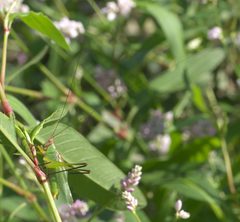
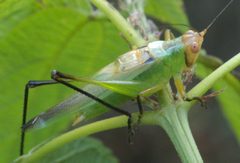
Orchelimum nigripes, commonly known as the black-legged meadow katydid, is a of meadow katydid in the Tettigoniidae. It is distributed across North America, with records from states including Alabama, Arkansas, Colorado, Illinois, and Indiana. The species belongs to the abundant Conocephalinae, which is prominent in the eastern United States and adjacent Canada. It hybridizes with the similar species Orchelimum pulchellum in parts of its range.
Pronunciation
How to pronounce Orchelimum nigripes: /ɔrˈkɛlɪməm ˈnɪɡrɪˌpɛs/
These audio files are automatically generated. While they are not always 100% accurate, they are a good starting point.
Identification
Distinguished from the similar Orchelimum pulchellum by range and associations; the two hybridize in the southeastern part of the range and along portions of the Potomac River. As a member of Orchelimum, it possesses the long, thread-like characteristic of katydids, contrasting with the shorter, thicker antennae of true grasshoppers. Specific diagnostic features for field identification are not documented in available sources.
Images
Habitat
Associated with tall grass including wetlands, lush meadows, and prairies. These environments are shared with other meadow katydids in the Conocephalinae.
Distribution
North America. Documented records from Alabama, Arkansas, Colorado, Illinois, and Indiana. Range overlaps with Orchelimum pulchellum in the southeastern United States.
Seasonality
Reaches maturity in late summer to early autumn, when are actively seeking mates. Activity period aligns with that of other eastern North American meadow katydids.
Diet
. Consumes grass seeds using powerful capable of cracking them; also feeds on leaves and flowers of forbs (flowering herbaceous plants excluding grasses, sedges, and rushes). Has been observed as an opportunistic on other insects, including acanaloniid planthoppers and smaller katydids, particularly when prey are injured.
Life Cycle
Development follows the typical pattern of , nymph, and stages. Adults reach maturity in late summer. During copulation, males transfer a consisting of a sperm container (ampulla) and a protein-rich gelatinous , which the female consumes after mating.
Behavior
Uses front to manipulate food items, directing morsels to the mouth in a manner resembling manual feeding. Females require additional protein for development and obtain nutritional investment from males via the , which reduces the likelihood of female remating. Opportunistic on injured insects has been observed.
Ecological Role
Contributes to energy flow in grassland and wetland . One study documented that three meadow katydid collectively converted nearly 16% of rush (Juncus) into insect biomass. Damage to developing seeds can reduce seed production of rushes and grasses by 30-50%.
Similar Taxa
- Orchelimum pulchellumHybridizes with O. nigripes in the southeastern part of its range and along portions of the Potomac River; the latter case possibly involves an introduced of O. nigripes.
More Details
Nomenclatural note
Catalogue of Life lists Orchelimum nigripes as a synonym, while GBIF and NCBI treat it as an accepted . This discrepancy suggests taxonomic revision may be ongoing.
Hybridization
The hybrid zone with O. pulchellum in the Potomac River region may represent secondary contact following introduction of O. nigripes, indicating potential human-mediated range expansion.