
Conocephalus strictus
(Scudder, 1875)
Straight-lanced Meadow Katydid
Conocephalus strictus, the straight-lanced meadow katydid, is a North American notable for the female's exceptionally long, straight ovipositor that exceeds body length. The exhibits wing dimorphism with short-winged (13–22 mm) and long-winged (21–30 mm) forms. appear in late summer and occur year-round in dry grasslands, old fields, and pastures where they form dense . Males produce a faint, pulsating purr at 10–20 kHz.
Pronunciation
How to pronounce Conocephalus strictus: /ˌkɒnoʊˈsɛfələs ˈstrɪktəs/
These audio files are automatically generated. While they are not always 100% accurate, they are a good starting point.
Identification
Distinguished from co-occurring Conocephalus fasciatus and Orchelimum by the female's conspicuously longer, straight ovipositor. Males identified by that are tapered beyond the tooth and flattened distally, versus shorter, differently shaped cerci in similar species. Wing dimorphism (short vs. long tegmina) present but not diagnostic alone. Song a faint, pulsating purr at 10–20 kHz, softer than many .
Images
Appearance
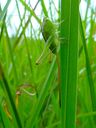
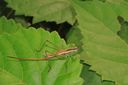
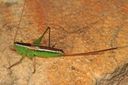
Large and robust for the Conocephalus. Body length ranges 13–30 mm depending on wing form. Coloration green and brown. Tegmina (forewings) short relative to body. Two distinct morphs exist: short-winged form (13–22 mm) and long-winged form (21–30 mm). Males possess long tapered beyond the tooth, flattened in their final third, and capable of extreme body bending. Females have a straight, sword-like ovipositor that exceeds body length—the ' namesake feature.
Habitat
Dry grasslands, old fields with grasses, and open areas of short grass along roadsides and in pastures. Prefers clumped vegetation where individuals aggregate in large numbers. Not associated with wetlands or dense woody vegetation.
Distribution
North America: central Arizona to southern Montana and southern New York to southern Georgia in the United States; extends into parts of Mexico and Canada.
Seasonality
first appear in late summer; occur year-round in suitable .
Diet
Grasses, with a focus on grass seeds. powerful enough to crack seeds.
Life Cycle
Hemimetabolous development with , nymph, and stages. Eggs deposited using the elongated ovipositor, likely inserted into soil or vegetation. Nymphs resemble miniature adults without wings. Adults reach maturity in late summer.
Behavior
Forms dense or clumps of individuals. Males stridulate to produce -specific song for mate attraction. Both sexes capable of powerful jumping using enlarged hind legs. Males exhibit extreme body bending, possibly related to mating or signaling.
Ecological Role
Primary consumer converting grass to insect biomass; significant herbivore in grassland . Serves as prey for predatory including Sphex ichneumoneus (Great Golden Digger Wasp), which paralyzes katydids to provision nests. studies indicate meadow katydids can convert substantial portions of plant biomass (e.g., 16% of Juncus biomass in one study) and reduce seed production of grasses and rushes by 30–50%.
Human Relevance
Subject of ecological research on grassland herbivory and plant-insect interactions. Song audible to humans with good high-frequency hearing or recording equipment, contributing to soundscape of North American grasslands. No documented agricultural pest status or economic importance.
Similar Taxa
- Conocephalus fasciatusCo-occurs in same range; distinguished by shorter ovipositor and in both sexes.
- Orchelimum vulgareSympatric meadow katydid with shorter ovipositor and ; belongs to different with generally larger body size.
More Details
Wing dimorphism
Presence of both short-winged (brachypterous) and long-winged () forms within may reflect strategies or environmental plasticity.
Etymology
Specific epithet 'strictus' and 'straight-lanced' refer to the female's straight, sword-like ovipositor.
Sources and further reading
- BugGuide
- Wikipedia
- GBIF taxonomy match
- iNaturalist taxon
- NCBI Taxonomy
- Minstrels of the meadow: Short-winged meadow katydid, Conocephalus brevipennis — Bug of the Week
- The Changing Distributions of our Grasshoppers, Crickets and Relatives - Buglife Blog - Buglife
- Bug Eric: Orthoptera Thursday: The Katydid's Menu
- What’s the difference between a cricket and a grasshopper? - Buglife Blog - Buglife
- Bug Eric: Wasp Wednesday: Great Golden Digger
- Bug Eric: October 2022