
Orchelimum vulgare
Harris, 1841
Common Meadow Katydid
Orchelimum vulgare, the common meadow katydid, is a North American in the Tettigoniidae. It inhabits fields and low meadows across the central and eastern United States and adjacent Canada. are active from midsummer through fall. The exhibits feeding habits, consuming plant material including grass seeds and forbs, as well as opportunistically preying on other insects.

Pronunciation
How to pronounce Orchelimum vulgare: //ɔːrˈkɛlɪməm vʌlˈɡeɪriː//
These audio files are automatically generated. While they are not always 100% accurate, they are a good starting point.
Identification
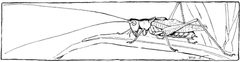
have bright red and green . The body is green with brown legs. Two distinct black lines are present on the shield (pronotum). The ovipositor is distinctly curved. Body length ranges from 22–40 mm, with females larger than males. The long, thread-like characteristic of katydids distinguish it from short-horned grasshoppers.
Images
Habitat
Fields and low meadows, where individuals perch on clumps of grass. Prefers moderate temperature climates; does not tolerate extreme heat or humidity well.
Distribution
Central and eastern North America. Records include Alabama, Arkansas, Colorado, Georgia, and Illinois.
Seasonality
Active from midsummer to fall.
Diet
Consumes grass seeds and forbs (flowering herbaceous plants that are not grasses, sedges, or rushes), including leaves and flowers. Opportunistically preys on other insects, including other Orthoptera, leafhoppers, and planthoppers. Has been observed eating other katydids.
Behavior
Males produce songs through stridulation (rubbing specialized structures on the forewings together) to attract females. Like other meadow katydids, uses front to manipulate food items while feeding.
Ecological Role
Functions as prey for various . Contributes to energy flow in grassland and meadow ; can convert substantial plant into insect biomass. Seed consumption can reduce seed production of rushes and grasses by 30–50%.
Similar Taxa
- Orchelimum nudipesAnother meadow katydid in the same ; O. vulgare distinguished by red , green , and two black pronotal lines
- Neobarrettia spinosaAlso a North American Tettigoniidae with formidable , but N. spinosa is larger, more robust, and has prominent spines; O. vulgare lacks these spines and has the diagnostic red and green
- Conocephalus spp.Smaller meadow katydids in the same ; O. vulgare is larger and has the distinctive red and curved ovipositor not seen in Conocephalus