
Conocephalus fasciatus
(De Geer, 1773)
slender meadow katydid
Species Guides
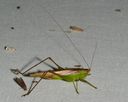
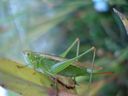
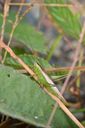
2Conocephalus fasciatus, commonly known as the slender meadow , is a small orthopteran insect native to the United States and Canada. It inhabits grassy and weedy areas across diverse environments including pastures, open pine woods, and roadsides. The is recognized by its slender body, long narrow wings, and distinctive alternating -and-buzz song. It feeds primarily on grasses and grass seedheads.
Pronunciation
How to pronounce Conocephalus fasciatus: /ˌkɒnoʊˈsɛfələs fæʃiˈeɪtəs/
These audio files are automatically generated. While they are not always 100% accurate, they are a good starting point.
Identification
Distinguished from similar meadow katydids by its slender build and wings that extend past the . The male's green with inner stout tooth and weakly flattened tip provide diagnostic characters. The song—a soft sequence of alternating ticks and buzzes lasting 1–20 seconds—differs from the continuous trills of some . Females are identified by the straight, relatively short ovipositor.
Images
Appearance
Small, slender with long, narrow wings extending beyond the . Body length 18–26 mm. Coloration typically a combination of brown and green. Males possess green with a stout tooth on the inner border and a weakly flattened tip. Females have a straight ovipositor approximately two-thirds the length of the hind .
Habitat
Grassy and weedy areas in pastures, open pine woods, roadsides, and other open with abundant grass cover.
Distribution
United States and southern Canada. Documented records include Alabama, Arizona, Arkansas, British Columbia, and California.
Seasonality
Active year-round in southern portions of range; present throughout growing season in northern areas.
Diet
Grasses and grass seedheads.
Life Cycle
laid using the ovipositor, likely inserted into plant tissue or soil. Development includes nymphal stages before adulthood. Specific details of stage not documented in sources.
Behavior
Males produce -specific songs consisting of alternating ticks and buzzes to attract females. Song duration varies from 1 to 20 seconds. Both sexes associated with grassy vegetation.
Ecological Role
Herbivore in grassland ; serves as prey for various including birds and other arthropods.
Human Relevance
Subject of bioacoustic study; song used in identification and behavioral research.
Similar Taxa
- Conocephalus brevipennisShort-winged meadow katydid has distinctly shorter wings not extending beyond and different song pattern consisting of buzzes and ticks with short pauses.
- Conocephalus strictusStraight-lanced meadow katydid has longer, sword-like ovipositor and different preferences.
More Details
Acoustic communication
Song structure has been studied in relation to female mate choice; the buzz component may be particularly important in female preference.
Sources and further reading
- BugGuide
- Wikipedia
- GBIF taxonomy match
- NCBI Taxonomy
- Catalogue of Life
- What do insects do in winter? Migrants in the DMV: Common Buckeye, Junonia coenia, Variegated Fritillary, Euptoieta Claudia, Painted Lady, Vanessa cardui, Large Milkweed bug, Oncopeltus fasciatus — Bug of the Week
- Minstrels of the meadow: Short-winged meadow katydid, Conocephalus brevipennis — Bug of the Week
- Bugs in Orange and Black II: Large milkweed bug, Oncopeltus fasciatus — Bug of the Week
- Orange and Black II: Milkweed leaf beetle, Labidomera clivicollis; Oleander aphid, Aphis nerii; Milkweed Bug, Oncopeltus fasciatus; Monarch, Danaus plexippus — Bug of the Week
- Bugs in orange and black - Monarch butterfly, Danaus plexippus Milkweed Bug - Oncopeltus fasciatus; Milkweed tiger moth, Euchaetes egle — Bug of the Week
- Orange and Black Bugs- Milkweed leaf beetle, Labidomera clivicollis; Oleander aphid, Aphis nerii; Milkweed Bug - Oncopeltus fasciatus; Monarch butterfly, Danaus plexippus — Bug of the Week