
Pristoceuthophilus arizonae
Hebard, 1935
Arizona camel cricket
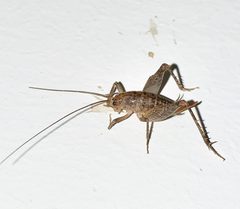
Pristoceuthophilus arizonae is a of camel cricket ( Rhaphidophoridae) described by Hebard in 1935. As a member of the Rhaphidophoridae, it belongs to a group of wingless, orthopterans commonly associated with dark, moist microhabitats. The species is to the southwestern United States, with confirmed records from Arizona.
Pronunciation
How to pronounce Pristoceuthophilus arizonae: //ˌprɪstoʊˌsjuːˈθɒfɪləs ˌærɪˈzoʊni//
These audio files are automatically generated. While they are not always 100% accurate, they are a good starting point.
Identification
Members of the Pristoceuthophilus can be distinguished from other camel crickets by the presence of prominent spines on the hind tibiae and modifications of the male genitalia. Pristoceuthophilus arizonae specifically requires examination of male terminalia for definitive identification, as external overlaps with related in the genus. The species lacks wings, has long exceeding body length, and possesses the humpbacked profile characteristic of Rhaphidophoridae.
Images
Habitat
Based on -level and collection locality data, this likely occupies rocky areas, caves, mine adits, and forest floor litter in montane and canyon environments of southeastern Arizona. Camel crickets in this genus typically require high humidity and darkness, retreating deep into crevices during daylight hours.
Distribution
Confirmed from Arizona, United States. The specific epithet and collection records indicate occurrence in the Sky Island mountain ranges of southeastern Arizona, including the Chiricahua Mountains. Distribution records from GBIF and iNaturalist support presence in this region, though precise range boundaries remain undocumented.
Behavior
and photophobic, consistent with -level traits. Camel crickets in this are known to aggregate in suitable microhabitats and may exhibit limited due to winglessness.
Ecological Role
Serves as a decomposer in cave and rocky , processing organic detritus. Likely functions as prey for cave-dwelling including spiders, pseudoscorpions, and small vertebrates.
Similar Taxa
- Ceuthophilus spp.Other camel cricket in the same , but distinguished by tibial spine arrangement and male genitalic structure
- Pristoceuthophilus cercocercusCongeneric with overlapping range; requires detailed examination of male genitalia for separation
More Details
Taxonomic note
The Pristoceuthophilus was erected to accommodate previously placed in Ceuthophilus that exhibit distinctive male genitalic . P. arizonae is one of approximately 15 species currently recognized in the genus, most of which are restricted to western North America.
Collection history
The was collected in Arizona, with the specific epithet reflecting this type locality. Modern records from iNaturalist and museum collections remain sparse, suggesting either genuine rarity or difficulty of detection due to cryptic habits.