
Pristoceuthophilus
Rehn, 1903
nutcracker camel crickets
Species Guides
3- Pristoceuthophilus arizonae(Arizona camel cricket)
- Pristoceuthophilus celatus
- Pristoceuthophilus cercalis(camel cricket)
Pristoceuthophilus is a of North American camel crickets ( Rhaphidophoridae) characterized by sexually dimorphic hind leg armaments in males. Males possess enlarged femoral spines and bent tibiae used for both intrasexual combat and sexual coercion of females. The genus contains at least 13 described and several undescribed , primarily distributed in the western United States and Mexico. These crickets inhabit forested and riparian environments, with some species showing phenological isolation at sympatric sites.
Pronunciation
How to pronounce Pristoceuthophilus: //ˌprɪstoʊˌsjuːˈθɒfɪləs//
These audio files are automatically generated. While they are not always 100% accurate, they are a good starting point.
Identification
Distinguished from other camel cricket by male hind leg modifications: enlarged femoral spines combined with bent tibiae forming a grasping apparatus. The 'nutcracker' nickname refers to males' tendency to squeeze fingers with hind legs when handled. -level identification requires examination of genitalia and geographic context; some undescribed species are morphologically similar to described .
Images
Appearance
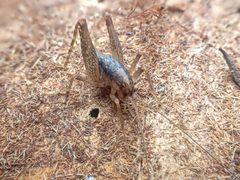
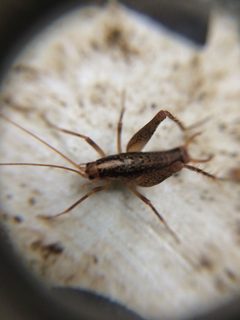
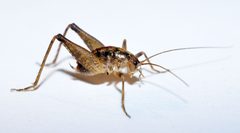
Medium to large camel crickets with humpbacked profile, long , and spiny hind legs. Males exhibit pronounced hind leg modifications: enlarged femoral spines and bent tibiae forming grasping structures. in leg armament is pronounced; females lack these modifications. Coloration varies by from gray to mahogany-brown. Body surface may bear or marmorated (marbled) patterning in some species.
Habitat
Mixed conifer forest, riparian woodland, and montane environments. Elevation range spans from lowland sites (200m) to high elevation (2300m). Specific associations vary by : P. 'Huachuca summer' and P. 'Mt. Pinos' in mixed conifer forest, P. 'Madera' and P. marmoratus in riparian woodland.
Distribution
Western North America: United States (Arizona, California, Montana, Oregon) and Mexico (southwestern region). Documented localities include Huachuca Mountains and Santa Rita Mountains in Arizona; Santa Monica Mountains, Mt. Pinos in Los Padres National Forest in California.
Seasonality
activity varies by and elevation. P. 'Huachuca summer' adults present in July; P. arizonae, P. 'Madera', and P. marmoratus adults active September-October. Phenological isolation observed between sympatric species: P. arizonae (gray, autumn) and P. 'Huachuca summer' (mahogany-brown, summer) co-occur at same site with non-overlapping adult periods.
Life Cycle
Hemimetabolous development. Juveniles collected in July can be reared to adulthood under laboratory conditions. timing varies by and site elevation, suggesting temperature-dependent . stage not explicitly documented.
Behavior
activity pattern. Males engage in intrasexual hind leg fighting: grappling with hind legs and attempting to pin opponents in leg locks. Sexual includes both voluntary copulation (female climbs onto male's back without leg contact) and forced copulation (male clamps female with one or both hind legs, forcibly inserts genitalia while female remains on ground). Sexual coercion appears more frequent in smaller males as a condition-dependent alternate strategy.
Human Relevance
Laboratory studies have used Purina Cat Chow and oatmeal for maintenance and collection. The 'nutcracker' reflects their defensive leg-squeezing when handled by humans.
Similar Taxa
- CeuthophilusSimilar camel cricket in same (Ceuthophilinae); males lack the combined enlarged femoral spines and bent tibiae characteristic of Pristoceuthophilus
- DaihiniaAnother ceuthophiline with different male genitalia and leg structure; lacks the pronounced hind leg armaments of Pristoceuthophilus
More Details
Evolutionary significance of male armaments
The hind leg modifications in Pristoceuthophilus represent an evolutionary exaptation: structures originally selected for intrasexual combat acquired a secondary function in sexual coercion. This dual-purpose armament system is rare among animals and has been documented in multiple across the , suggesting a shared evolutionary history.
Undescribed species
At least three undescribed species have been studied (P. 'Huachuca summer', P. 'Madera', P. 'Mt. Pinos'), indicating substantial undocumented diversity. The 'Samwel Cave cricket' has been informally assigned to this but remains undescribed.