
Cycloptilum trigonipalpum
(Rehn & Hebard, 1912)
forest scaly cricket
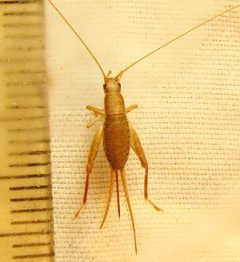
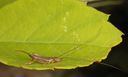
Cycloptilum trigonipalpum, known as the forest scaly , is a of scaly cricket in the Mogoplistidae. It is a small orthopteran insect found in forested across southeastern and midwestern North America. The species was first described by Rehn and Hebard in 1912. It is one of the more frequently observed members of its , with over 400 iNaturalist records documenting its presence.
Pronunciation
How to pronounce Cycloptilum trigonipalpum: //saɪˌklɒptɪˈlʌm trɪˌɡɒnɪˈpælpəm//
These audio files are automatically generated. While they are not always 100% accurate, they are a good starting point.
Identification
Distinguished from other Mogoplistidae by the triangular palps indicated in its name. Separated from true crickets (Gryllidae) by the presence of -like body covering rather than typical setae. Within the Cycloptilum, identification to species level requires examination of male genitalia and palp structure. The "forest scaly " helps distinguish it from more open- relatives.
Images
Appearance
Small with body covered in distinctive -like setae, a characteristic feature of the Mogoplistidae. The name "trigonipalpum" refers to the triangular shape of the palps. Typical coloration is dark with a somewhat flattened body form compared to true crickets (Gryllidae). are long and thread-like, extending well beyond the body length.
Habitat
Forest environments, including deciduous and mixed woodlands. Found in leaf litter, under bark, and in other moist, sheltered microhabitats within forested areas. The specific epithet association with forest distinguishes it from occupying more open or disturbed environments.
Distribution
Southeastern and midwestern United States. Documented occurrences include Alabama, Florida, Georgia, Illinois, and Louisiana. The range appears centered on the Gulf Coastal Plain and lower Mississippi Valley, with extensions into the southern Appalachian region.
Ecological Role
Member of the forest floor , contributing to decomposition processes through feeding on decaying organic matter. Serves as prey for small vertebrates and in forest . The -like body covering may provide protection against and desiccation in the humid microhabitats it occupies.
Human Relevance
No documented direct economic or agricultural significance. Occasionally encountered by naturalists and entomologists conducting biodiversity surveys in eastern North American forests. The contributes to baseline data for regional orthopteran diversity assessments.
Similar Taxa
- Cycloptilum bidens with overlapping range; distinguished by differences in male genitalia and palp structure, and typically occupies more open
- Gryllidae (true crickets)Superficially similar orthopterans; distinguished by lack of -like body covering, different wing venation, and typically more robust body form
- Myrmecophilidae (ant crickets)Small orthopterans sometimes confused with scaly crickets; distinguished by obligate association and different body structure
More Details
Taxonomic history
Originally described by Rehn and Hebard in 1912, this has remained within the Cycloptilum through subsequent taxonomic revisions. The Mogoplistidae has undergone significant reclassification, previously treated as a of Gryllidae before elevation to family status based on morphological and molecular evidence.
Observation frequency
With over 400 iNaturalist observations, this is among the most frequently documented in the Mogoplistidae, likely reflecting both its actual abundance and its occurrence in relatively accessible forest in populated regions of the eastern United States.