
Mogoplistidae
Costa, 1855
Scaly Crickets and Allies
Genus Guides
3- Cycloptilum(Common Scaly Crickets)
- Hoplosphyrum(scaly crickets)
- Oligacanthopus
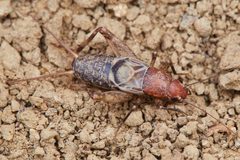
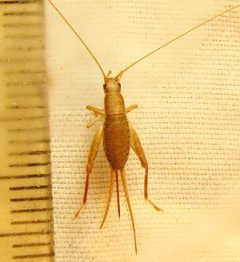
Mogoplistidae is a of scaly crickets within the superfamily , comprising over 370 in approximately 30 worldwide. The family is considered monophyletic and sister to the true crickets (Gryllidae). Members are distinguished by covering the and parts of the , resembling those of Lepidoptera. The family includes three : Mogoplistinae, Malgasiinae (restricted to Madagascar and Indian Ocean islands), and the extinct †Protomogoplistinae known from Burmese amber.
Pronunciation
How to pronounce Mogoplistidae: /ˌmɒɡoʊˈplɪstɪˌdiː/
These audio files are automatically generated. While they are not always 100% accurate, they are a good starting point.
Identification
Members of Mogoplistidae are distinguished from related by the presence of covering the and portions of the , resembling the scales of Lepidoptera (butterflies and moths). This scaly covering is the primary diagnostic feature separating them from Gryllidae and other grylloid families.
Images
Habitat
Tropical and subtropical environments, often near water. Some are specialized for coastal : the Atlantic beach (Pseudomogoplistes vicentae) inhabits cobble beaches, while the Mediterranean beach cricket (Pseudomogoplistes squamiger) occupies narrow belts of suitable coastal habitat. The Scaly Cricket (Pseudomogoplistes vicentae) in the UK lives amongst shingle and under large stones on beaches with large shingle.
Distribution
Worldwide distribution with particular diversity in tropical regions. North America: 20 in 4 . Europe: includes the scaly crickets. Madagascar and Indian Ocean islands: Malgasiinae. Atlantic coasts: from North Africa to Great Britain, including Morocco, Portugal, Spain, France, Channel Islands, Wales, and England. Slovenia: Mediterranean beach recently confirmed. East Asia: multiple Ornebius species described from China.
Diet
scavenging. Has been observed feeding on fungi, plant material, and other insects.
Life Cycle
of at least some take approximately one year to hatch. The Scaly (Pseudomogoplistes vicentae) lays eggs in driftwood using a long ovipositor (up to 5mm in females with body length up to 13mm), burying them deep for protection.
Human Relevance
Some are rare and of conservation concern. The Scaly (Pseudomogoplistes vicentae) and Field Cricket (Gryllus campestris) are legally protected in the UK. Strandline and beach-dwelling species depend on driftwood for shelter and -laying; removal of driftwood for beach cleaning or burning threatens .
Similar Taxa
- GryllidaeTrue crickets are sister to Mogoplistidae but lack the distinctive scaly covering on and ; Mogoplistidae resemble those of Lepidoptera.
- RhaphidophoridaeCave crickets share long and habits but lack and have different body proportions; Mogoplistidae are not restricted to cave .
Sources and further reading
- BugGuide
- Wikipedia
- GBIF taxonomy match
- iNaturalist taxon
- NCBI Taxonomy
- Catalogue of Life
- What’s the difference between a cricket and a grasshopper? - Buglife Blog - Buglife
- Driftwood: The real treasure lining our beaches. - Buglife Blog - Buglife
- Prva potrditev pojavljanja obalnega murna Pseudomogoplistes squamiger (Fischer, 1853) (Orthoptera: Mogoplistidae) v Sloveniji First confirmation of Mediterranean beach-cricket Pseudomogoplistes squamiger (Fischer, 1853) (Orthoptera: Mogoplistidae) occurring in Slovenia
- A new species of Ornebius Guérin-Méneville, 1844 from East China (Orthoptera: Mogoplistidae: Mogoplistinae)
- First observations of the Atlantic beach cricket, Pseudomogoplistes vicentae (Grylloidea: Mogoplistidae), in the Basque autonomous community, Spain
- First report of a wingless species of Ornebius—a scaly cricket usually with winged males (Orthoptera: Mogoplistidae: Mogoplistinae)
- Morphometric variability and life history traits of the rareParamogoplistes novakiin comparison toMogoplistes brunneus(Orthoptera: Mogoplistidae)