
Neoscapteriscus vicinus
(Scudder, 1869)
tawny mole cricket
Neoscapteriscus vicinus, the tawny , is a burrowing orthopteran native to South America that has become established in the southeastern United States since its introduction around 1900. The was reclassified from to the new Neoscapteriscus in 2015 based on morphological differences. It is a significant agricultural and turf pest that damages plants through root feeding and tunneling activities.
Pronunciation
How to pronounce Neoscapteriscus vicinus: //ˌni.oʊˌskæp.təˈɹɪs.kʊs ˈvɪ.sɪ.nəs//
These audio files are automatically generated. While they are not always 100% accurate, they are a good starting point.
Identification
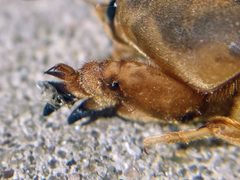
Distinguished from the closely related Neoscapteriscus borellii by the two fore claws that are almost touching at the base (widely separated in N. borellii). Other possess three or four claws on the fore legs. The male's 130 Hz trill song is also diagnostic.
Images
Habitat
Sandy soils in turfgrass, pastures, and agricultural fields. Burrows in the upper 25 cm of soil, with depth varying by temperature and soil moisture.
Distribution
Native to South America (Argentina, Bolivia, Brazil). Introduced to the United States where it occurs from North Carolina to Louisiana, throughout Florida, and west to Texas.
Seasonality
active in spring and autumn in Florida; completes one lifecycle during summer; overwinters as large nymph.
Diet
Herbivorous; feeds on roots and young shoots of plants. Documented damaging bermudagrass, bahiagrass, tomatoes, strawberries, vegetables, peanuts, sugarcane, tobacco, and ornamental plants.
Host Associations
- bermudagrass - primary turfgrass
- bahiagrass - pasture
- tomatoes - crop plant
- strawberries - crop plant
- peanuts - crop plant
- sugarcane - crop plant
- tobacco - crop plant
Life Cycle
One per year. Breeding occurs in spring and autumn. Male calls after sunset to attract females. Female lays 25–60 in underground chamber, sealing entrance with soil. Eggs hatch in approximately 3 weeks. Nymphs develop through 8–10 over several months. Overwinters as large nymph; do not survive winter.
Behavior
; burrows just below soil surface. Creates extensive tunnel systems that loosen soil around plant roots, causing desiccation and plant death. Males produce loud trilling calls to attract females.
Ecological Role
Root herbivore and soil disturber. In its native range, subject to by Larra bicolor, parasitoid fly , and .
Human Relevance
Major pest of turfgrass, pastures, and multiple crop plants. Subject of extensive research in Florida, where introduced natural enemies from South America achieved 95% reduction in northern Florida by 2004. Economic analysis showed cost/benefit ratio of 1:52 for biological control program. No labeled for control in forage crops; soap flush method used for detection.
Similar Taxa
- Neoscapteriscus borelliiSimilar appearance and distribution; distinguished by widely separated fore claws (vs. almost touching in N. vicinus)
- Scapteriscus didactylusFormerly congeneric; true are smaller group with different
More Details
Taxonomic History
Reclassified from vicinus to Neoscapteriscus vicinus in 2015 by Oscar Cadena-Castañeda based on morphological analysis showing two distinct groups within the former .
Biological Control Success
Florida program using South American natural enemies achieved 95% reduction in by 2004, with cost/benefit ratio of 1:52 documented in 2016 economic analysis.
Sources and further reading
- BugGuide
- Wikipedia
- GBIF taxonomy match
- iNaturalist taxon
- NCBI Taxonomy
- Catalogue of Life
- Hay and Pasture Insects - AgriLife Extension Entomology
- Encyrtid Holdings | Entomology Research Museum
- Pismire Puzzle | Beetles In The Bush
- Rhizobacterial treatment of bermudagrass increases tolerance to damage from tawny mole crickets (Neoscapteriscus vicinus Scudder)