
Neoscapteriscus
Cadena-Castañeda, 2015
mole crickets
Species Guides
4- Neoscapteriscus abbreviatus(short-winged mole cricket)
- Neoscapteriscus borellii(Southern Mole Cricket)
- Neoscapteriscus didactylus(Changa)
- Neoscapteriscus vicinus(tawny mole cricket)
Neoscapteriscus is a of two-clawed mole crickets (Gryllotalpidae) containing at least 23 described . Members are subterranean insects with forelegs adapted for tunneling. Several species are significant turfgrass and pasture pests in the Americas, including the tawny (N. vicinus) and southern mole cricket (N. borellii). The genus was established by Cadena-Castañeda in 2015, separating these species from the related genus .
Pronunciation
How to pronounce Neoscapteriscus: //ˌniː.oʊˌskæpˈtɛr.ɪskəs//
These audio files are automatically generated. While they are not always 100% accurate, they are a good starting point.
Identification
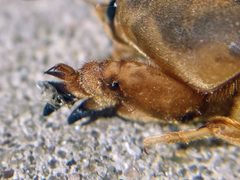
Distinguished from by the presence of two claws on the foretibiae rather than four. Forelegs are broad, spade-like, and modified for digging. Body cylindrical, with reduced wings in some . Specific species-level identification requires examination of genitalia and detailed morphological features.
Images
Habitat
Subterranean in sandy or loose soils. Associated with turfgrass systems, pastures, golf courses, and lawns where soil conditions permit tunneling.
Distribution
Caribbean; Brazil; Argentina (Northeast, South, Northwest). Distribution records primarily from South America and Caribbean islands.
Diet
Root-feeding herbivores. N. vicinus has been documented feeding on bermudagrass (Cynodon dactylon) roots.
Host Associations
- bermudagrass - herbivoreCynodon dactylon; documented for N. vicinus
Behavior
Constructs extensive tunnel systems through soil. Tunneling uproots plants and damages root systems. Exhibits avoidance behavior to certain including fipronil and imidacloprid, detected through contact chemoreception. Shows increased locomotory activity and tunneling in response to acephate and bifenthrin exposure. Reduced spatial movement observed with fipronil and imidacloprid exposure.
Human Relevance
Significant agricultural and turfgrass pests. Tunneling and root-feeding damage reduces forage quality in pastures and degrades turf aesthetics. Target of applications including fipronil, imidacloprid, bifenthrin, and acephate. Subject to research including rhizobacterial treatments to enhance plant .
Similar Taxa
- ScapteriscusHistorically congeneric; distinguished by four claws on foretibiae versus two in Neoscapteriscus
More Details
Taxonomic history
established in 2015 by Cadena-Castañeda, reclassifying formerly placed in . Contains at least 23 described species including economically important pests N. vicinus and N. borellii.
Sources and further reading
- BugGuide
- Wikipedia
- GBIF taxonomy match
- iNaturalist taxon
- NCBI Taxonomy
- Catalogue of Life
- Behavioral responses of pest mole crickets, Neoscapteriscus spp. (Orthoptera: Gryllotalpidae), to selected insecticides
- Rhizobacterial treatment of bermudagrass increases tolerance to damage from tawny mole crickets (Neoscapteriscus vicinus Scudder)