
Tetrix arenosa
Burmeister, 1838
Obscure pygmy grasshopper, Obscure grouse locust
Tetrix arenosa is a Nearctic of pygmy in the Tetrigidae, one of approximately 35 tetrigid species in North America. are minute, typically around 1 cm in length, with the pronotum extending backward over the —a characteristic feature of the family. The species has been documented in at least 82 iNaturalist research-grade observations, placing it among the more frequently recorded North American pygmy grasshoppers. Two are recognized: T. a. arenosa and T. a. angusta.
Pronunciation
How to pronounce Tetrix arenosa: //ˈtɛtrɪks ˌæɹəˈnoʊsə//
These audio files are automatically generated. While they are not always 100% accurate, they are a good starting point.
Identification
Distinguished from other North American Tetrix by the combination of: variable but often present white pronotal marking; bold white femoral stripes against cryptic background; and relatively large size for the (approaching 15 mm in some individuals). Tetrix ornata has a more consistently patterned pronotum. Tettigidea typically show different pronotal proportions and lack the distinct white femoral markings. T. arenosa exhibits greater color than most .
Images
Appearance
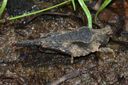
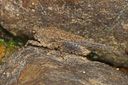
Small-bodied pygmy with pronotum extending posteriorly over the . Coloration is highly variable, including light forms, dark forms, mottled forms, and bi-colored forms. A variable white blotch or marking has been observed on the pronotum. Hind bear bold white markings that contrast with otherwise cryptic coloration. Body length approaches or slightly exceeds 10 mm in some individuals, relatively large for the .
Habitat
Associated with moist environments including stream margins, pond edges, and wet leaf litter. Has been observed in open woodland transitioning to dry dolomite glade , suggesting for varied moisture conditions within broader wetland or riparian zones.
Distribution
Nearctic region: documented from Alabama, Arkansas, Florida, Illinois, and Indiana. Distribution likely broader across eastern and central North America based on associations and related ranges.
Life Cycle
with , nymph, and stages. Nymphs resemble small adults but lack fully developed wings. Specific developmental duration unknown.
Behavior
Exhibits strong , remaining motionless when disturbed on suitable substrate. Capable of jumping when provoked but may rely on immobility for avoidance. Has been observed perching on vegetation and artificial structures (e.g., net rims) in field conditions.
Ecological Role
Presumably contributes to leaf litter decomposition and serves as prey for small vertebrates and in wetland and riparian . Specific ecological functions unstudied.
Human Relevance
Subject of amateur naturalist observation and photography; featured in entomological blogs discussing and color . No known agricultural or economic significance.
Similar Taxa
- Tetrix ornataSimilar size and preference; differs in having more consistent pronotal patterning rather than the variable white blotch of T. arenosa
- Tettigidea lateralisOverlaps in and region; distinguished by different pronotal proportions, generally smaller size, and lack of bold white femoral markings
- Tetrix subulataHolarctic with overlapping ; T. arenosa distinguished by Nearctic distribution and more pronounced color
Misconceptions
Small size frequently leads to misidentification as grasshoppers (Acrididae); are fully mature at <15 mm. The Tetrigidae is often overlooked due to this size misconception.
More Details
Subspecies
Tetrix arenosa arenosa Burmeister, 1838 and Tetrix arenosa angusta (Hancock, 1896) are the two recognized , though their diagnostic boundaries require further study.
Color polymorphism
The exhibits exceptional intraspecific variation in coloration, with light, dark, mottled, and bi-colored forms documented from single —providing material for studies on selection and genetic variation.