
Tettigidea lateralis
(Say, 1824)
black-sided pygmy grasshopper, black-sided grouse locust, sedge grouse locust
Tettigidea lateralis is a of pygmy in the Tetrigidae, commonly known as the black-sided pygmy grasshopper or sedge grouse locust. It is one of the most frequently observed pygmy grasshoppers in North America, with over 4,000 iNaturalist observations. The species is notable for its relatively large size among Tetrigidae, reaching approximately 15 mm in length, and for its distinctive bold white femoral markings that contrast with otherwise cryptic coloration. It occurs across a broad geographic range including North America, the Caribbean, and parts of Central America.
Pronunciation
How to pronounce Tettigidea lateralis: //ˌtɛtɪˈɡiːdiə ˌleɪtəˈreɪlɪs//
These audio files are automatically generated. While they are not always 100% accurate, they are a good starting point.
Identification
Distinguished from other Tetrigidae by its relatively large size and distinctive white femoral markings. Tettigidea armata and Tetrix ornata also possess similar white bands, but T. lateralis is generally larger and more robust. The shows considerable intraspecific variation in coloration, which can complicate identification based on color alone. The combination of size, white femoral markings, and geographic range helps separate it from similar species. may be confused with nymphs of other grasshoppers due to short wings, but the enlarged pronotum characteristic of Tetrigidae is diagnostic for the .
Images
Appearance
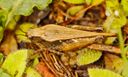
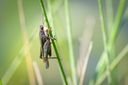
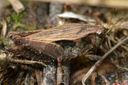
A relatively large pygmy , reaching approximately 15 mm in length—substantially larger than typical Tetrigidae. Body coloration is highly variable, ranging from light to dark forms with mottled or bi-colored patterns. The most distinctive feature is the bold white marking on the , which contrasts sharply with the otherwise cryptic coloration. The pronotum is relatively short in females. Wings are short when present. Overall body form is typical of the : small, somewhat flattened, with an enlarged pronotum that extends backward over the .
Habitat
Found in moist environments near streams and other wet areas, though also observed in dry dolomite glades and open woodlands. Occurs in leaf litter and ground-level vegetation. The appears to tolerate a range of moisture conditions from wet riparian zones to relatively dry glade .
Distribution
North America (United States, Canada), Caribbean Sea region, and Central America including Guatemala, Honduras, Nicaragua, Rica, and Panama. Within North America, recorded from Vermont and across much of the eastern and central United States.
Behavior
When disturbed, individuals may remain motionless rather than fleeing immediately, suggesting reliance on . The white femoral markings may function as , breaking up the body outline against varied substrates. One observer noted an individual sitting motionless on barren dolomite when placed there, rather than attempting escape.
Human Relevance
One of the most commonly observed and photographed pygmy grasshoppers in North America, making it an accessible subject for natural history observation and citizen science documentation. Frequently encountered by entomologists and naturalists in field surveys.
Similar Taxa
- Tettigidea armataAlso possesses white femoral band, but differs in other morphological features
- Tetrix ornataSimilar white banding pattern, but generally smaller and with different pronotal structure
- Tetrix arenosaHas variable white blotch on pronotum rather than femoral markings
More Details
Subspecies
Two are recognized: Tettigidea lateralis lateralis (Say, 1824) and Tettigidea lateralis cazieri Rehn & Grant, 1958
Taxonomic History
Originally described as Acrydium laterale by Say in 1824, later transferred to the Tettigidea
Sources and further reading
- BugGuide
- Wikipedia
- GBIF taxonomy match
- iNaturalist taxon
- NCBI Taxonomy
- Catalogue of Life
- A “Giant” Pygmy | Beetles In The Bush
- July | 2011 | Beetles In The Bush | Page 2
- Orthoptera | Beetles In The Bush | Page 5
- crypsis | Beetles In The Bush | Page 2
- The mini grasshoppers that outlived dinosaurs: the fascinating world of Tetrigidae | Blog