
Aeropedellus clavatus
(Thomas, 1873)
Club-horned Grasshopper, Clubhorned Grasshopper, Slant-faced Grasshopper
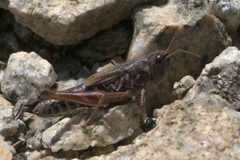
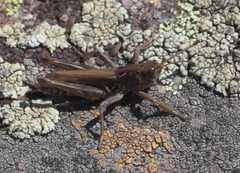
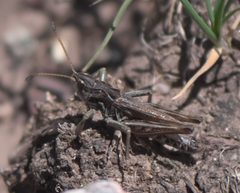
Aeropedellus clavatus, commonly known as the club-horned , is a medium-sized slant-faced grasshopper in the Acrididae. It is distinguished by its club-shaped , with the last six segments enlarged and darker than the rest. The exhibits pronounced : females are flightless with short wings, while males may have either short or long wings, with long-winged males capable of . It is one of the earliest-hatching grasshoppers in its range, emerging in early spring and completing development rapidly. are most abundant in the Canadian prairies, where it is the most widely distributed grassland grasshopper species.
Pronunciation
How to pronounce Aeropedellus clavatus: /ˌɛəroʊpəˈdɛləs kləˈveɪtəs/
These audio files are automatically generated. While they are not always 100% accurate, they are a good starting point.
Identification
The club-shaped with six enlarged, dark terminal segments are diagnostic and give the its . The hourglass-shaped constriction in the lateral pronotal carinae is characteristic of slant-faced grasshoppers but particularly notable here. The combination of slanted , oblong lateral fovolae, and the distinctive striping (dark streak from to base with cream band anteriorly) separates it from similar species. Flightless females with short wings and white genal marks are distinctive. In nymphs, the grey medial hind with pale grey lower marginal area, combined with the head and pronotal patterns, allows identification.
Images
Appearance
are medium-sized, 16–22 mm in length, with coloration ranging from light brown and grey to green, marked with black or silver patterns. The has a strongly slanted with two oblong lateral fovolae (indentations) on top. A dark streak runs from beneath the to the base of the , with a cream or light tan band to it. The pronotum has and lateral carinae (ridges) cut by a groove behind the middle; the lateral carinae constrict near the middle of the prozona, forming an hourglass-shaped marking. A pale diagonal mark is often present on the vertical sides of the pronotum. The hind wing is clear, and the hind tibia is light brown. Females have short wings that do not reach the middle of the and white marks on the genae; males are smaller (16–18 mm vs. 19–22 mm) and may have long wings. Nymphs progress through four instars, with strongly slanted faces, oblong lateral fovolae, a narrow light stripe above a thick dark stripe running from behind the compound eye to the abdomen, and hind femurs with entirely grey medial areas and pale grey lower marginal areas. Male nymphs develop beginning at the second instar, while female nymphs retain flat antennae with little variation in width.
Habitat
Northern mixed-grass prairies, mountain meadows, forested foothills, and alpine tundra above timberline. In the Canadian prairies, occurs on dry and somewhat sandy areas south of the forest. One resident survives above timberline at 13,600 feet in rocky, grass-sedge in Colorado.
Distribution
North America, from western Canada (prairie provinces: Alberta, Saskatchewan, Manitoba) through the northern United States (Montana, North Dakota, Nebraska, Wyoming) to the southwestern United States (mountains of Arizona and New Mexico). Most abundant and widely distributed grassland in the Canadian prairies.
Seasonality
Very early-hatching ; nymphs emerge in the first week of May in eastern Wyoming, about ten days before the bigheaded grasshopper. Hatching period lasts three to four weeks. In alpine areas above timberline in Colorado, hatching begins mid to late June depending on altitude and seasonal temperatures. Nymphal development completes in approximately 30 days on plains and 42 days in alpine . present from late spring through summer.
Diet
Primarily grasses and sedges, including western wheatgrass, prairie junegrass, Sandberg bluegrass, needle-and-thread, threadleaf sedge, and needleleaf sedge. Kentucky bluegrass (Poa pratensis) is a preferred when available. Grass seeds and glumes are heavily consumed when available. Known to feed on at least 28 of grasses and six species of sedges. Small amounts of forbs, fungi, pollen, and parts have been found in crop contents but appear incidental.
Host Associations
- Poa pratensis - preferred food plantmost favored food plant when present
- Pascopyrum smithii - food plantwestern wheatgrass
- Koeleria macrantha - food plantprairie junegrass
- Poa secunda - food plantSandberg bluegrass
- Hesperostipa comata - food plantneedle-and-thread
- Carex filifolia - food plantthreadleaf sedge
- Carex eleocharis - food plantneedleleaf sedge
Life Cycle
One per year in plains . are laid in pods of 5–8 in soil among roots of grasses or sedges; pods are 10–13 mm long, 3.5–4.0 mm in diameter, oriented vertically. Eggs develop rapidly to stage 26 (embryo nearly ready to hatch) then enter for winter. In alpine habitats, eggs may remain in diapause for two or possibly three winters before hatching. Nymphs progress through four instars, developing rapidly to become in 30–42 days. Early hatching provides access to abundant green vegetation but exposes nymphs to intensive before later-hatching emerge.
Behavior
generally remain in the same area where they hatched and developed. Long-winged males frequently fly for short periods and distances; some evidence suggests they may migrate. Adult males spend more time crawling on the ground than females, which move slowly and remain motionless for long periods. When threatened, females hop away from ; males hop away then 'prance'—taking small, repeated hops without appreciable forward progression. Males stridulate by vibrating the hind against a raised on the tegmen, producing a loud scratching sound, probably for courtship.
Ecological Role
Primary consumer feeding on grasses and sedges; serves as prey for birds, rodents, spiders, and insects. Early hatching makes it particularly vulnerable to , with typically reducing densities to fewer than one per square yard by early summer. Its rapid development allows exploitation of high-quality forage before later-hatching competitors emerge.
Human Relevance
Occasional pest of forage grasses and cereal grains. Not generally economically important, but dense (up to 20 per square yard on rangeland in Canada) can cause severe damage to forage grasses. recorded in 1936 in Saskatchewan destroyed 300 acres of wheat. Frequently abundant in infesting rangeland in Montana and North Dakota.
Similar Taxa
- Ageneotettix deorumBoth are early-hatching Gomphocerinae in similar ; A. deorum has white whisker-like markings on the and lacks clubbed
- Aulocara elliottiSimilar slant-faced grasshopper in same ; A. elliotti has a proportionally larger and different pronotal markings
- Amphitornus coloradusStriped slant-faced grasshopper with similar body shape; A. coloradus has bold lateral stripes and thread-like without clubbing
- Chorthippus curtipennisMeadow grasshopper with overlapping range; C. curtipennis has shorter wings relative to body and lacks the distinctive markings and clubbed
Sources and further reading
- BugGuide
- Wikipedia
- GBIF taxonomy match
- iNaturalist taxon
- NCBI Taxonomy
- Catalogue of Life
- Grasshoppers of Colorado
- Clubhorned Grasshopper
- Grasshoppers of Colorado
- Grasshoppers of Colorado
- Species Records and Accounts
- List of Species Fact Sheets| Grasshoppers of Wyoming and the West
- Life History of Aeropedellus clavatus (Orthoptera: Acrididae) in the Alpine Tundra of Colorado